
When a new Bitcoin fork launches, one question usually appears almost immediately:
Which exchanges will list it?
For many cryptocurrencies, exchange support determines whether holders can easily buy, sell or discover a market price for the new asset.
But eCash (ECX) is being built around a different possibility.
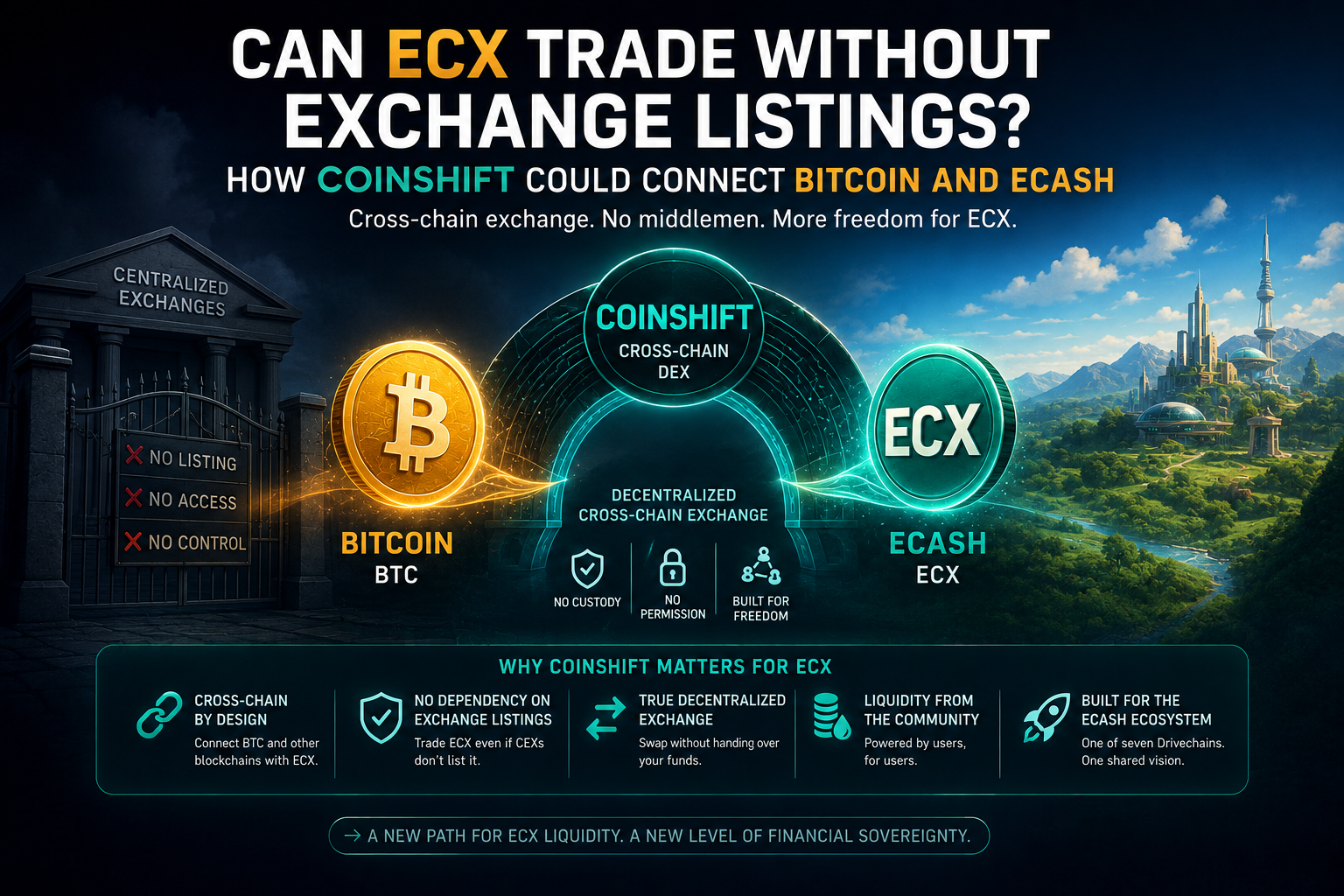
One of the seven planned eCash Drivechains, CoinShift, is designed to provide cross-chain exchange infrastructure — including a potential path between Bitcoin and ECX without requiring a traditional centralized exchange to sit between them.
If it works as intended, ECX may not need to wait for a major exchange listing before a BTC/ECX market can exist.
That does not mean centralized exchanges become irrelevant.
And it certainly does not guarantee liquidity.
But it could change one of the fundamental assumptions surrounding the launch of a Bitcoin fork.
Why Exchange Listings Matter for Bitcoin Forks
Historically, centralized exchanges have played an unusually powerful role during Bitcoin forks.
When a fork occurs, an exchange may have to decide whether it will:
- recognize the new blockchain.
- credit customers with the forked asset.
- support deposits and withdrawals.
- create trading pairs.
- provide market liquidity.
For users holding BTC directly in self-custody, the situation is different.
If the fork's rules make their Bitcoin address eligible and they control the corresponding keys, they may be able to access the new asset independently.
But receiving a forked asset and having a market where it can trade are two separate problems.
A holder may successfully receive ECX and still ask:
Where can I exchange it?
That is the problem CoinShift is intended to address.
What Is CoinShift?
CoinShift is one of the seven eCash Drivechains planned for the eCash ecosystem.
Its purpose is cross-chain decentralized exchange.
Rather than focusing on payments, privacy, identity or prediction markets, CoinShift is intended to connect value across different blockchain networks.
Bitcoin is the most important example.
Conceptually, this creates a path such as:
BTC ↔ CoinShift ↔ ECX
The objective is to allow Bitcoin and eCash users to exchange value without requiring a centralized company to custody both sides of the transaction.
This matters because Bitcoin and ECX exist on separate blockchains.
A decentralized exchange that operates entirely within one blockchain cannot automatically solve that problem.
CoinShift is being designed specifically around it.
Why Can't ECX Just Use a Normal DEX?
When people hear "decentralized exchange," platforms such as Uniswap may immediately come to mind.
But there is an important difference.
A typical DEX works primarily with assets that already exist inside the same compatible blockchain environment.
Swapping one Ethereum token for another is relatively straightforward because both assets follow rules understood by the same network.
Bitcoin and ECX are different.
They are independent blockchain networks.
A BTC-to-ECX exchange therefore has to deal with two chains, two transaction histories and potentially different confirmation and reorganization conditions.
CoinShift is intended to operate at this boundary between blockchains.
That makes its job fundamentally different from simply swapping two tokens inside a single smart-contract ecosystem.
The Bigger Idea: ECX Without Permission From an Exchange
This is where CoinShift becomes particularly interesting.
Imagine ECX Mainnet launches.
Bitcoin holders receive or claim their ECX.
Wallet infrastructure exists.
The network is producing blocks.
But major centralized exchanges decide not to list ECX immediately.
In the traditional model, that creates a serious bottleneck.
Users have the asset, but there may be no convenient market for it.
CoinShift attempts to make another outcome possible:
the ECX ecosystem can provide its own path between Bitcoin and ECX.
A centralized exchange would no longer be the only entity capable of creating that bridge.
This does not mean ECX would never benefit from exchange listings.
Listings can provide substantial liquidity, visibility, fiat access and easier onboarding.
The important distinction is between:
benefiting from exchange listings
and
depending entirely on exchange listings to function.
CoinShift is an attempt to reduce that dependency.
Alpha Already Gave Us a Small Preview
The first ECX Alpha provided an interesting demonstration of how quickly demand for exchange infrastructure can appear.
Within roughly two days of Alpha launching, a community member built a simple browser-based market for BTC and practice ECX.
It used a constant-product automated market maker.
There were no major exchange integrations.
No institutional market makers.
No large liquidity providers.
The market was simply created because people participating in Alpha wanted a way to trade the new experimental asset.
And they used it.
The experiment was tiny.
Liquidity was only around \$100, which meant trades could move the implied price dramatically.
At different moments, pECX prices swung from very high values to tiny fractions as the reserves changed.
Those prices should not be treated as meaningful valuations of permanent ECX.
But the experiment demonstrated something more useful:
as soon as ECX existed, demand for a market appeared.
CoinShift is intended to address that same demand with infrastructure designed specifically for cross-chain exchange.
Liquidity Is Still the Hard Problem
This is the most important limitation to understand.
Building an exchange protocol does not automatically create a liquid market.
You can build perfect BTC/ECX swap infrastructure and still have a poor trading experience if almost nobody provides BTC or ECX liquidity.
Alpha demonstrated this clearly.
With approximately \$100 of liquidity, even small trades could produce extreme price movements.
A useful CoinShift market would therefore require participants willing to provide meaningful liquidity.
This leads to two separate questions:
Can BTC and ECX be exchanged without a centralized exchange?
CoinShift is being developed to make that technically possible.
Will there be enough liquidity to make those trades efficient?
That depends on actual market participation.
The second question cannot be solved by software alone.
CoinShift vs. Centralized Exchanges
CoinShift and centralized exchanges solve some of the same problems, but in very different ways.
A centralized exchange typically provides:
Custody\ Users deposit assets into wallets controlled by the exchange.
Order matching\ The exchange operates the trading infrastructure.
Liquidity\ Market makers and customers provide buy and sell orders.
Account infrastructure\ Users generally interact through registered exchange accounts.
Listing control\ The exchange decides which assets it supports.
CoinShift aims at a different model.
The objective is to provide cross-chain exchange without making one centralized company the mandatory custodian and gatekeeper for the market.
That changes who controls access.
But decentralization does not magically remove every problem.
Liquidity still matters.
Blockchain confirmation times still matter.
Reorganizations still matter.
Software risk still matters.
Cross-chain coordination still matters.
CoinShift replaces one architecture with another — not complexity with magic.
CoinShift vs. THORChain
A closer conceptual comparison is THORChain.
THORChain demonstrated that native assets from different blockchains can be exchanged without wrapping everything into tokens on one smart-contract chain.
That makes it much closer to what CoinShift is attempting than a conventional single-chain DEX.
But there is an important architectural difference.
THORChain has its own native token, RUNE, which plays a central role in its security and liquidity model.
CoinShift is intended to operate within the eCash Drivechain architecture rather than introducing another independent exchange token as the center of the system.
ECX remains part of the economic environment.
This reflects a broader philosophy behind the seven eCash Drivechains:
specialized functionality does not necessarily require launching another unrelated cryptocurrency for every application.
Where ECX Fits Into CoinShift
CoinShift is not an isolated product attached to eCash.
It is part of a larger Drivechain architecture.
The seven planned eCash Drivechains specialize in different functions:
Thunder — payments\ Truthcoin — prediction markets\ zSide — privacy\ BitAssets — digital assets and tokens\ BitNames — decentralized names and identity\ Photon — quantum-resistant storage\ CoinShift — cross-chain exchange
Instead of trying to place all of these functions directly onto the ECX base chain, each environment can specialize.
ECX provides the common economic connection between them.
CoinShift's role is particularly important because it potentially connects that internal ecosystem with assets outside it.
And Bitcoin is the most obvious place to start.
Could CoinShift Connect More Than BTC and ECX?
Potentially, yes.
Bitcoin is the natural first external asset because eCash itself originates from a Bitcoin fork and its initial holder base is closely connected to BTC.
But the broader CoinShift concept is cross-chain exchange rather than simply one permanent BTC/ECX trading pair.
Additional blockchain integrations could expand the number of assets that can interact with the eCash economy.
That is a longer-term possibility rather than something users should assume is available today.
The immediate significance is simpler:
creating a native path between Bitcoin and ECX.
What About Exchanges That Do Support ECX?
CoinShift does not require centralized exchanges to disappear.
In fact, multiple forms of liquidity could coexist.
A future ECX holder might have several options:
Use a centralized exchange.
Trade peer-to-peer.
Use OTC liquidity.
Use CoinShift.
Or move between several of these markets depending on price, liquidity and convenience.
That would be healthier than having the entire ECX market depend on a single venue.
Competition between trading venues can also improve price discovery.
The important goal is optionality.
What If No Major Exchange Lists ECX?
Then ECX faces a harder path to liquidity and mainstream accessibility.
That should not be minimized.
Large exchanges can expose an asset to millions of users and deep pools of existing capital.
But lack of a major listing does not necessarily mean an asset becomes technically untradeable.
Peer-to-peer markets can exist.
OTC markets can exist.
Community markets can exist.
And if CoinShift operates as intended, native cross-chain markets can exist.
Alpha already demonstrated the basic human behavior behind this.
People had pECX.
Other people had BTC.
Someone built a market connecting them.
CoinShift attempts to turn that improvised behavior into part of the network's infrastructure.
Why This Matters for Bitcoin Holders
For Bitcoin holders eligible for ECX, exchange listings are actually a later question.
The first question is whether an eligible ECX allocation exists.
The second is whether you control the Bitcoin keys required to access that allocation.
Only after that does the question of where ECX can eventually be held, used or traded become relevant.
You can use the ECX Claim Checker to check a public Bitcoin address and review its ECX allocation information.
The eligibility check requires only a public BTC address.
A private key or recovery phrase is not required simply to check eligibility.
Your BTC remains on the Bitcoin network.
ECX exists separately on the eCash network.
Receiving ECX Is Not the Same as Selling ECX
This distinction is especially important.
Claiming or receiving ECX does not require immediately trading it.
And the existence of CoinShift should not be interpreted as a promise that a liquid BTC/ECX market will exist at a particular date or price.
These are separate layers:
Bitcoin snapshot → ECX eligibility
ECX claim → control of the ECX allocation
ECX wallet → storage and transactions
CoinShift / exchanges / P2P → potential markets
Separating these concepts helps avoid one of the most common misunderstandings around cryptocurrency forks.
A claim mechanism determines who can access an asset.
An exchange mechanism determines how that asset can trade.
A Fork That Does Not Have to Wait for Permission
Perhaps the most interesting part of CoinShift is philosophical rather than technical.
Bitcoin itself did not begin with major exchange listings.
Markets emerged because people wanted to exchange it.
Bitcoin forks later developed in an environment where centralized exchanges had become extremely powerful. Their decisions could determine whether millions of custodial users received a forked asset and whether an accessible market appeared.
CoinShift asks whether a Bitcoin-derived network can reduce that dependency.
Not eliminate exchanges.
Not eliminate liquidity providers.
Not eliminate markets.
But eliminate the assumption that one centralized company must first give permission for a market to exist.
If CoinShift succeeds, that could become one of the most practical applications in the entire eCash Drivechain ecosystem.
Because before ECX can be used in prediction markets, privacy systems, digital assets or other applications, users need ways to move value into and out of the ecosystem.
CoinShift is being built to provide one of those doors.
And for a new Bitcoin-derived asset, having that door built into the ecosystem could matter almost as much as what exists on the other side of it.
Check Whether Your Bitcoin Address Is Eligible for ECX
Before worrying about where ECX may eventually trade, Bitcoin holders can first determine whether their BTC address is associated with an ECX allocation.
Only a public Bitcoin address is required for the eligibility check.
Never provide a private key or recovery phrase merely to check whether a Bitcoin address is eligible for ECX.