
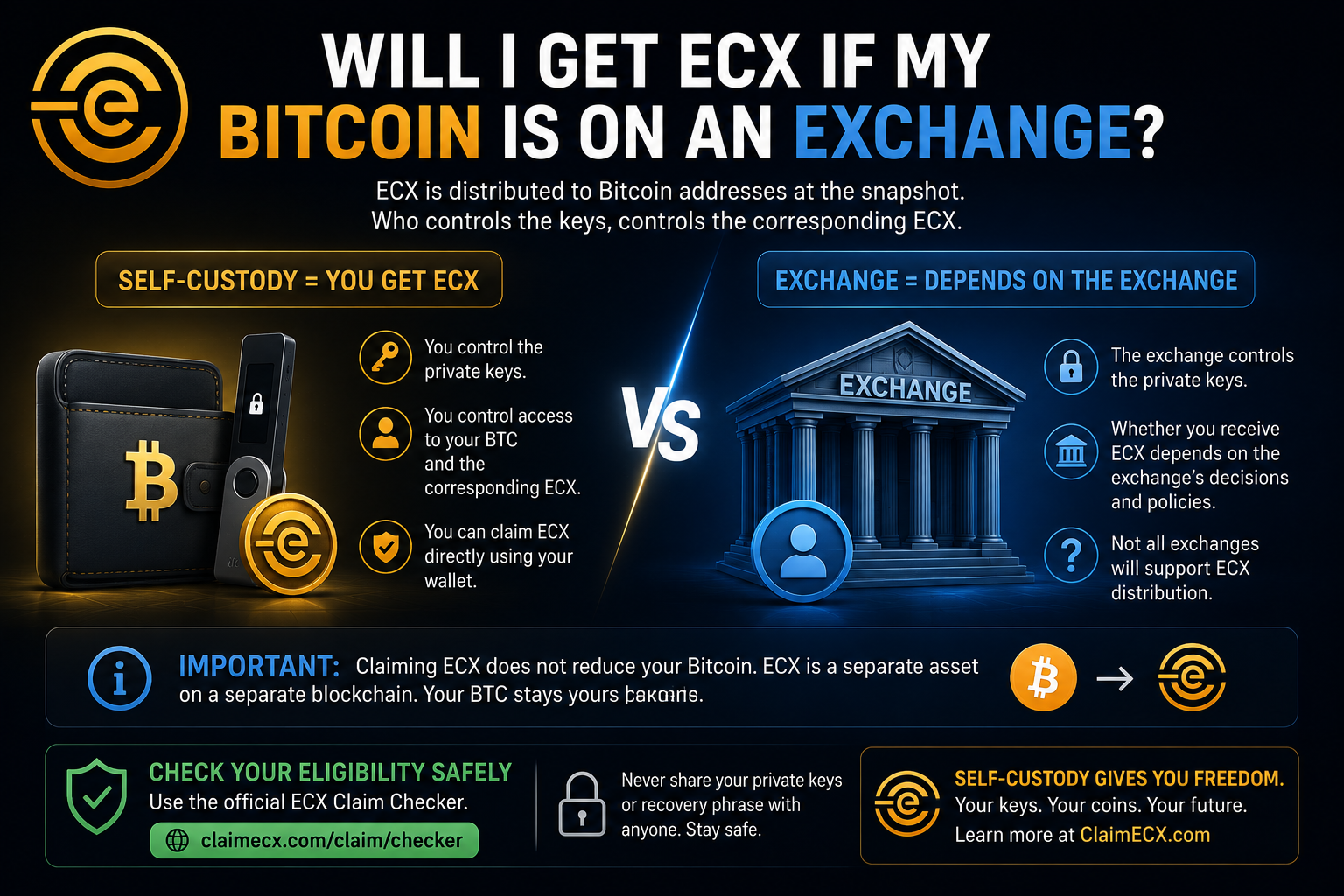
If your Bitcoin is held on a cryptocurrency exchange when the ECX Mainnet snapshot occurs, you are not guaranteed to receive the corresponding ECX directly.
The ECX snapshot works at the Bitcoin address level. At Mainnet, eligible Bitcoin addresses are expected to receive permanent ECX at a 1 BTC = 1 ECX ratio under the network's distribution rules.
But if your BTC is on an exchange, you normally do not control the private keys to the Bitcoin address holding those coins.
The exchange does.
That means access to the corresponding ECX is controlled by the exchange's wallet infrastructure, and whether ECX is distributed to you depends on the exchange's policy toward the fork.
ClaimECX cannot guarantee that any third-party exchange will distribute ECX to its customers.
Self-Custody vs. Exchange: Who Controls the ECX?
The easiest way to understand the difference is to ask:
Who controls the Bitcoin private keys at the snapshot?
| Where your BTC is held | Who controls the keys? | Who controls access to corresponding ECX? |
|---|---|---|
| Self-custody wallet | You | You |
| Hardware wallet you control | You | You |
| Cryptocurrency exchange | Exchange | Exchange |
| Custodial wallet provider | Provider | Provider |
If you hold BTC in a self-custody wallet, the private keys associated with your Bitcoin addresses remain under your control.
If an exchange holds your BTC, its wallets — not your exchange account balance — are represented on the Bitcoin blockchain at the snapshot.
The exchange therefore controls the keys associated with the corresponding forked ECX.
Does the Exchange Automatically Owe Me ECX?
Not necessarily.
A Bitcoin balance displayed in an exchange account represents the exchange's accounting of what it holds on your behalf. It does not normally mean you control a dedicated Bitcoin private key containing exactly that amount.
When ECX forks from Bitcoin, the blockchain itself does not know which exchange customer owns what portion of a custodial wallet.
It only sees Bitcoin addresses and balances.
The exchange must decide whether it will:
- support the ECX fork.
- calculate customer allocations.
- credit ECX balances.
- enable ECX deposits or withdrawals.
- or not support ECX at all.
Different exchanges may make different decisions.
What If My Exchange Supports ECX?
If an exchange officially announces support for the ECX fork and distribution, it may credit eligible customers according to its own snapshot and distribution rules.
In that case, follow the exchange's official instructions.
Do not assume that every platform will use exactly the same timing, eligibility rules or withdrawal schedule.
Most importantly, an ECX allocation at the blockchain level does not automatically mean an exchange customer will immediately see ECX in their account.
What If My Exchange Does Not Support ECX?
This is the important part.
If your BTC is held by an exchange at the relevant snapshot and the exchange does not distribute ECX, ClaimECX cannot independently recover that ECX for you.
The reason is simple:
ClaimECX cannot give you control over private keys that belong to an exchange.
The corresponding ECX may exist on the eCash blockchain, but the exchange controls the credentials required to access the forked balance.
This is fundamentally different from self-custody.
Can I Use the ECX Claim Checker for Bitcoin Held on an Exchange?
You can check a public Bitcoin address if you know the actual address that held BTC at the snapshot.
But an exchange deposit address may not accurately represent where the exchange held your BTC at the snapshot.
Exchanges may consolidate customer deposits into internal hot or cold wallets.
For that reason, checking an old exchange deposit address does not necessarily tell you whether the exchange owes you ECX.
For custodial BTC, the exchange's official fork policy is the relevant source.
What If I Move My Bitcoin to Self-Custody?
Timing matters.
Permanent ECX is determined by the Bitcoin state at the Mainnet snapshot.
Moving BTC after the relevant snapshot does not retroactively change which address held the Bitcoin at that snapshot.
Likewise, Alpha or Beta eligibility should not be treated as guaranteed Mainnet eligibility because Bitcoin balances can change between snapshot blocks.
If you are considering moving BTC, remember that custody decisions involve their own security considerations.
ClaimECX does not recommend moving Bitcoin solely to obtain a forked asset.
Does Receiving ECX Reduce My Bitcoin Balance?
No.
ECX is not taken out of your BTC.
The fork creates a separate blockchain. Your BTC continues to exist on Bitcoin, while the corresponding ECX exists separately on the eCash network.
The question for exchange users is therefore not:
"Will my BTC be converted into ECX?"
It will not.
The question is:
"Will my exchange give me access to the ECX associated with the Bitcoin it held on my behalf?"
Only the exchange can answer that.
Before attempting to move or claim forked coins, review replay protection and Bitcoin fork safety.
The Bottom Line
If you held Bitcoin in self-custody, you control the keys associated with your BTC addresses and can directly access the corresponding ECX under the fork's rules.
If you held Bitcoin on an exchange, the exchange controls those keys.
So:
BTC in self-custody → you control access to ECX. BTC on an exchange → ECX distribution depends on the exchange.
Before assuming you will receive ECX, check your exchange's official announcement about the fork.
For Bitcoin addresses you control yourself, use the ECX Claim Checker to check eligibility using only a public BTC address.
No private key or recovery phrase is required.