
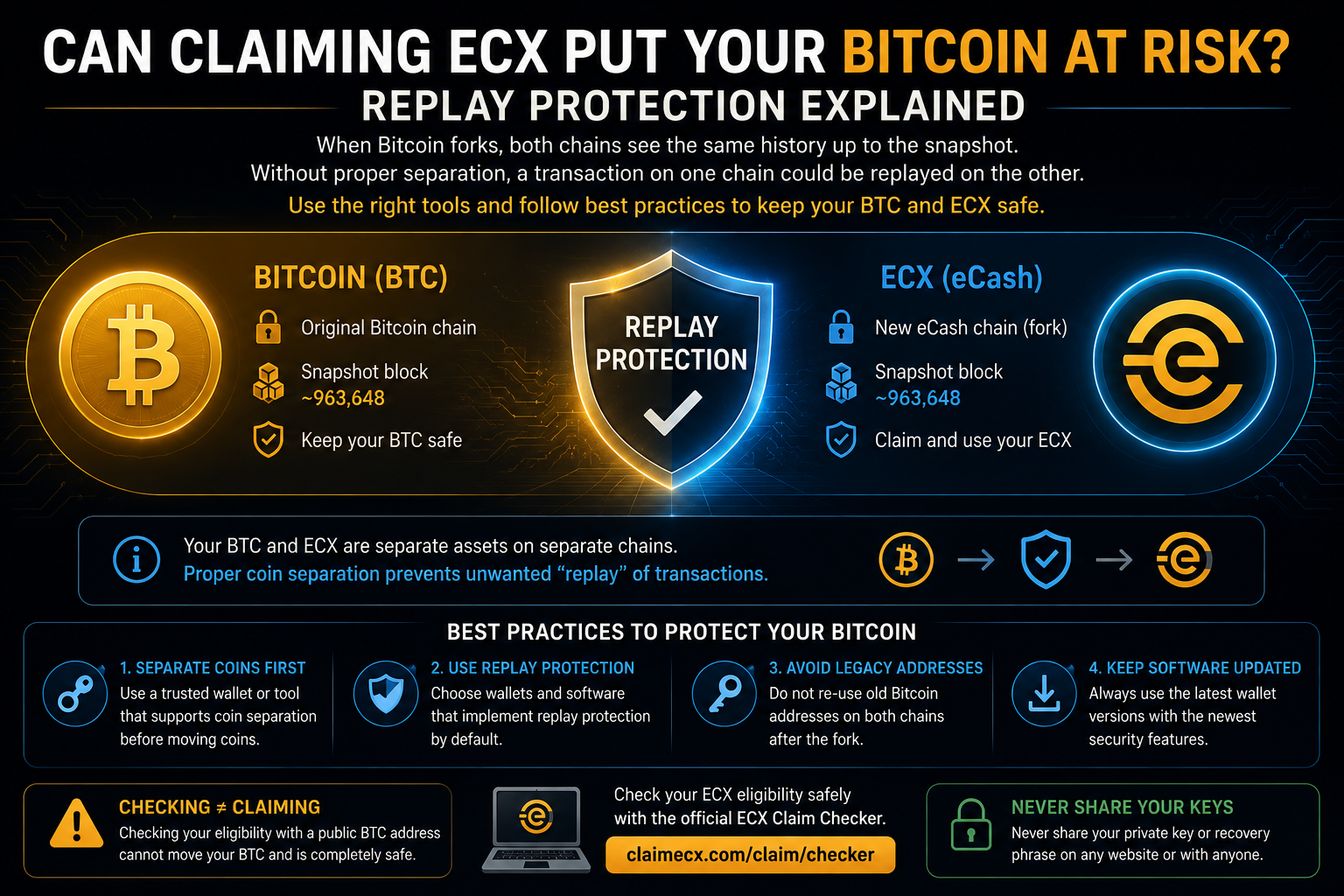
When Bitcoin creates a hard fork, the same ownership history can suddenly exist on two independent blockchains.
That is what makes a fork valuable to eligible holders: if you controlled BTC at the relevant snapshot, the corresponding keys may also give you control over coins created on the new chain.
But it also creates an important security question:
Can trying to claim or move ECX accidentally put your Bitcoin at risk?
Potentially, yes — if the two chains have not been properly separated and transactions can be replayed across them.
This does not mean that simply checking whether your Bitcoin address is eligible for ECX puts your BTC at risk.
Checking an allocation and actually spending forked coins are completely different operations.
Understanding that distinction is the first step toward handling a Bitcoin fork safely.
Quick Answer: Can Claiming ECX Affect Your BTC?
Checking your ECX eligibility cannot move your Bitcoin when the check uses only a public BTC address.
The ECX Claim Checker only needs a public Bitcoin address to look up allocation information.
A public address does not contain the private key required to spend BTC.
The security question becomes more important later, when users begin interacting with the private keys or recovery phrases that control coins sharing a common pre-fork history.
At that stage, coin separation and replay protection matter.
Why Bitcoin Forks Create Two Sets of Coins
Imagine a Bitcoin address contains:
1 BTC
A hard fork begins from Bitcoin's existing transaction history.
At the fork point, the new blockchain recognizes the historical ownership recorded before the split.
Under the ECX distribution model, an eligible balance may therefore result in:
Bitcoin chain: 1 BTC
eCash chain: 1 ECX
These are now separate assets on separate blockchains.
Your BTC has not been converted.
Nothing has been deducted from Bitcoin simply because another chain exists.
But there is an important technical detail.
Both chains inherited historical information from the same source.
That means the private key that controlled the pre-fork Bitcoin output may initially be relevant to coins on both sides of the fork.
That shared history is why users need to understand replay attacks.
What Is a Replay Attack?
A replay attack in a blockchain fork occurs when a transaction valid on one chain can also be accepted on the other chain.
Suppose Bitcoin and ECX have split, but the coins associated with your keys have not yet been clearly separated.
You create a transaction intending to move coins on Chain A.
If Chain B recognizes essentially the same transaction as valid, someone may be able to rebroadcast — or "replay" — it there.
Instead of moving coins only where you intended, a corresponding movement may occur on both chains.
That is the core replay problem.
The risk is not that the fork somehow reaches into Bitcoin and steals BTC automatically.
The risk comes from transaction compatibility between two chains that share history.
A Simple Replay Example
Consider a simplified example.
Before the fork:
Address A → 1 BTC
After the fork:
Bitcoin: Address A → 1 BTC
eCash: Address A → 1 ECX
Now imagine you create a transaction on the eCash side:
Address A → Address B
You intended to move only ECX.
If the transaction is also valid under Bitcoin's rules and the coins have not been separated, a replay of that transaction could potentially cause the corresponding BTC to move as well.
The exact mechanics depend on the rules implemented by each chain.
But the security principle is simple:
a transaction intended for one fork should not unintentionally become a valid transaction on the other.
What Is Replay Protection?
Replay protection is a mechanism that prevents a transaction created for one blockchain from being valid on another.
There are several ways a fork can achieve this.
A protocol may change transaction rules so signatures or transactions are chain-specific.
A wallet or splitting tool may create transactions that deliberately become different across the two chains.
Or users may first create a transaction history that exists on only one side of the fork.
The goal is always the same:
make BTC and ECX independently spendable.
Once the relevant coins are properly separated, moving ECX should no longer imply moving the corresponding BTC, and vice versa.
What Does "Splitting Coins" Mean?
Coin splitting does not mean dividing one cryptocurrency into smaller pieces.
It means breaking the shared transaction relationship between assets created by a blockchain fork.
Before separation, the BTC and ECX associated with a pre-fork output may have matching histories.
After successful separation, the two sides have diverged.
A simplified model looks like this:
Before split
same pre-fork ownership → BTC + ECX
After split
BTC → Bitcoin-only transaction history
ECX → eCash-only transaction history
From that point forward, transactions can be handled independently.
This is why coin splitting has historically been an important part of safely accessing assets created by Bitcoin forks.
ECX Alpha Already Tested Coin Separation
ECX Alpha was designed as a live rehearsal rather than the permanent network.
During Alpha, users and developers experimented with separating Bitcoin-side ownership from practice ECX.
One documented technique used nLockTime to create a transaction that could become valid under different conditions across the two chains.
The important point is not that every future ECX holder should manually reproduce an Alpha experiment.
They should not.
The important point is that Alpha provided an environment where coin-separation behavior could be tested before permanent Mainnet.
That is exactly the type of problem Alpha and Beta are intended to expose.
Why Replay Risk Matters More Than the ECX Allocation Check
There is a major security difference between these two actions:
Checking ECX Eligibility
You provide:
a public Bitcoin address
The system reads public blockchain information.
No transaction is created.
No BTC is moved.
No private key is required.
Claiming or Moving ECX
At some point, the process may require proving control over the keys associated with the eligible Bitcoin ownership.
Now private-key security, wallet software, transaction construction and coin separation become relevant.
This is why users should not treat "check" and "claim" as interchangeable words.
Checking is a read-only blockchain lookup. Claiming is a key-sensitive operation.
Do I Need My Bitcoin Private Key to Check ECX?
No.
A private key is not required simply to determine whether a Bitcoin address has an ECX allocation.
You can use the ECX Claim Checker with the public BTC address.
If a website asks for your Bitcoin private key, seed phrase or recovery phrase merely to tell you whether an address is eligible, stop.
That information is unnecessary for a public-address eligibility lookup.
Why Private Keys Become Sensitive During a Fork
A private key is fundamentally different from a Bitcoin address.
A public Bitcoin address is designed to be shared.
A private key is designed to authorize spending.
If the same key controls value derived from a common pre-fork history, exposing that key to untrusted software may endanger more than the forked asset you are trying to access.
This is why the safest fork-handling procedures focus on two independent problems:
- Protect the key itself.
- Separate the coins before treating the two chains as independent.
Replay protection solves the second problem.
It does not solve the first.
A perfectly replay-protected blockchain cannot protect you if you voluntarily enter your seed phrase into malicious software.
Replay Attack vs. Stolen Private Key
These risks are often confused.
Replay Attack
You authorize a legitimate transaction on one chain.
Because the chains remain transaction-compatible, the transaction is reproduced on the other chain.
Private-Key Theft
You expose a private key or recovery phrase to malicious software.
The attacker creates entirely new transactions using your credentials.
These are different attacks.
Coin separation can help prevent replay.
It cannot make a compromised seed phrase safe again.
That is why ECX claim security should include both transaction safety and key safety.
Should You Move Your BTC Before Claiming ECX?
There is no universal answer that applies to every fork procedure.
Moving BTC can be part of a conservative fork-claim strategy because it can move the valuable Bitcoin balance to keys that were not present at the fork snapshot before the old keys are used elsewhere.
But doing this incorrectly while replay conditions still exist can create its own complications.
The correct order depends on the actual Mainnet software, replay protections and supported splitting procedure available at the time you claim.
For that reason, users should follow the current how to claim ECX instructions rather than improvising a sequence based on an older Bitcoin fork.
Do not move funds solely because a generic fork guide tells you to. Verify the current ECX procedure first.
Why Mainnet Instructions Matter More Than Alpha Experiments
Alpha and Beta exist for testing.
Techniques demonstrated on a practice chain are useful because they reveal problems and allow developers to test solutions.
But a successful Alpha experiment should not automatically be treated as the final Mainnet procedure.
Wallet software can change.
Splitting tools can improve.
Protocol behavior can change.
Replay protections can change.
The safest Mainnet procedure is therefore the procedure verified for the actual permanent network at the time of claim.
ClaimECX will distinguish between testing-stage information and permanent Mainnet claim instructions.
Can a Replay Attack Happen Just Because You Hold ECX?
No.
Simply having corresponding assets on two chains does not itself broadcast a transaction.
Replay risk appears when transactions are created and the same transaction can remain valid across both networks.
If you do nothing, there is nothing to replay.
Likewise, checking a public address does not create a spend.
The risk is associated with moving unsplit forked coins, not merely owning them.
Does ECX Take Bitcoin Out of Your Wallet?
No.
The existence of an ECX allocation does not remove BTC from Bitcoin.
A Bitcoin hard fork creates a separate blockchain state.
Your Bitcoin remains governed by the Bitcoin network.
The ECX network separately recognizes its own asset according to its fork rules.
A problem can arise only if a user later handles keys or transactions unsafely.
This distinction matters because phrases such as "claim free coins" can make it sound as though BTC must be exchanged or surrendered.
That is not how a normal fork allocation works.
What About Hardware Wallets?
Hardware wallets can protect private keys from direct exposure, but they do not automatically solve every fork-specific problem.
A hardware device may protect the key while wallet software still constructs a transaction that behaves unexpectedly across two chains.
Users therefore need both:
key security and chain-aware transaction handling.
Before using a hardware wallet with ECX, verify that the wallet or supported procedure understands the eCash chain and the required separation process.
Do not assume that a Bitcoin wallet automatically knows how to handle ECX simply because the underlying keys originate from Bitcoin.
What About Recovery Phrases?
A recovery phrase may derive many private keys.
That makes it particularly sensitive.
Entering a recovery phrase into software gives that software potentially broad access to addresses derived from the seed.
If an ECX claim procedure requires a recovery phrase, users should understand exactly where the phrase is being processed and whether the software is trusted.
Never enter a recovery phrase into a random website simply because it promises to "split" or "unlock" ECX.
Read the recovery phrase guide before using a seed in any claim process.
What About a Single Private Key?
Some users may control an eligible address through an individual WIF private key rather than a full wallet recovery phrase.
That can reduce the scope compared with exposing an entire seed, but the key still controls the corresponding address.
It must therefore be treated as highly sensitive.
A private key should only be used in software you have intentionally chosen for the actual claim process.
See the private key guide for the distinction between a public Bitcoin address and the private credential controlling it.
A Safer Mental Model for Claiming a Bitcoin Fork
Think of the process as four separate stages.
Stage 1 — Check
Determine whether your public Bitcoin address is eligible.
Private keys are not needed.
Stage 2 — Verify
Confirm the network stage, official instructions, wallet support and current coin-separation procedure.
Do not rush into key-sensitive software.
Stage 3 — Separate
Ensure BTC and ECX can be spent independently using the procedure supported for the network.
Replay risk is addressed here.
Stage 4 — Claim or Move
Only after understanding the process should you use the private credentials required to access the forked asset.
This sequence is safer than treating "claim ECX" as one button that should be clicked immediately.
Seven Security Rules for ECX Holders
- Use a public BTC address to check eligibility first.
- Never provide a seed phrase merely to check an allocation.
- Do not assume Alpha procedures are final Mainnet procedures.
- Understand the current BTC/ECX coin-separation method before spending forked coins.
- Treat recovery phrases and private keys as high-risk credentials.
- Use software designed for the correct ECX network and stage.
- Do not rush. An ECX claim does not need to be completed simply because the network has launched.
The safest claim is one you understand before signing anything.
Frequently Asked Questions
Can checking my ECX balance move my Bitcoin?
No. A public-address eligibility lookup does not authorize a Bitcoin transaction.
Can claiming ECX automatically spend BTC?
Not simply because an ECX allocation exists. The relevant risk is whether a transaction involving unsplit forked coins can also be valid on the Bitcoin chain.
What is ECX replay protection?
Replay protection refers to mechanisms that prevent a transaction intended for one side of the Bitcoin/eCash fork from being valid on the other.
What does splitting BTC and ECX mean?
It means creating independent transaction histories so the BTC and ECX derived from the shared pre-fork ownership can be moved separately.
Do I need my seed phrase to check whether I have ECX?
No. A public Bitcoin address is sufficient for an eligibility lookup.
Should I claim ECX immediately after Mainnet?
There is no need to rush simply because the network launches. Review current security and coin-separation instructions before using private credentials.
Checking Is Not Claiming
The most important security lesson is also the simplest:
Checking whether you have ECX is not the same as claiming ECX.
An eligibility checker reads public blockchain data.
It does not need your Bitcoin private key.
It does not need your recovery phrase.
It does not create a Bitcoin transaction.
Replay protection becomes relevant when coins inherited from the same pre-fork history are actually moved.
At that point, BTC and ECX need to be handled as two independent assets on two independent networks.
Understanding that boundary lets Bitcoin holders investigate their ECX allocation without confusing a harmless public-address lookup with the more sensitive process of accessing and spending forked coins.
Check Your ECX Eligibility Without Exposing Your Keys
If you want to know whether a Bitcoin address has an ECX allocation, start with the read-only step.
Only a public Bitcoin address is required.
Do not enter a private key or recovery phrase merely to check whether your address is eligible.