
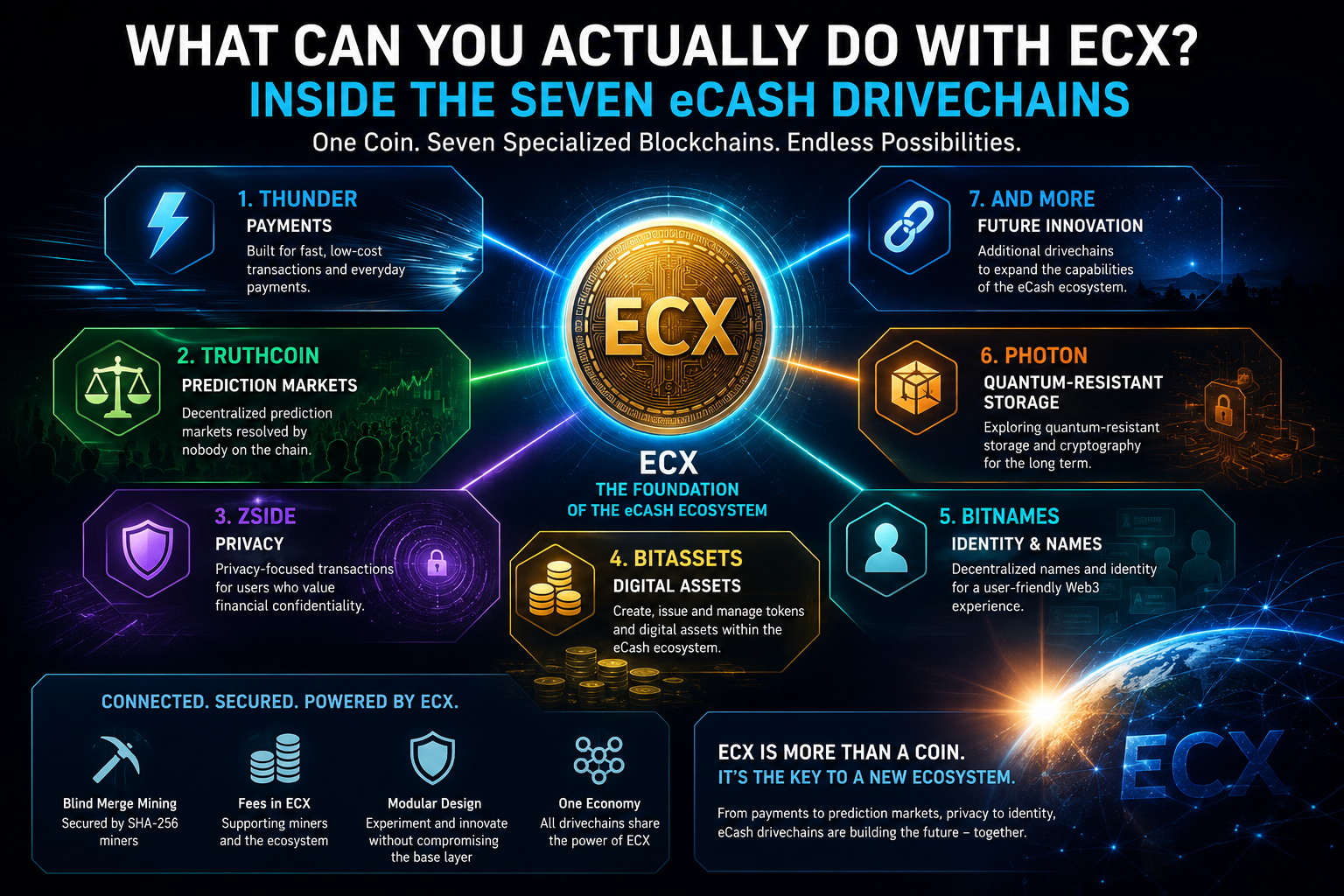
Receiving a new coin from a Bitcoin fork naturally raises a simple question:
What can you actually do with it?
For eCash (ECX), the answer is intended to extend beyond holding, sending or trading another Bitcoin-derived asset.
ECX is being developed as the base asset of a broader Drivechain ecosystem — a set of specialized blockchains designed to provide capabilities that do not need to be added directly to Bitcoin itself.
Payments, privacy, prediction markets, digital assets, identity and other experiments can exist on separate chains while remaining connected to the same underlying ecosystem.
For Bitcoin holders eligible to receive ECX, understanding these Drivechains helps explain what ECX is being built for — and why the project is more ambitious than a conventional Bitcoin fork.
ECX Is More Than a Forked Bitcoin Balance
When a Bitcoin fork occurs, eligible BTC holders may receive a corresponding allocation on the new network.
In the case of eCash, the planned distribution is based on Bitcoin ownership at the relevant snapshot, with an allocation ratio of:
1 BTC = 1 ECX
Your Bitcoin does not become ECX.
BTC remains on Bitcoin.
ECX exists separately on the eCash network.
But the larger idea behind ECX is not simply to create another blockchain that reproduces Bitcoin transactions.
The eCash architecture is designed around Drivechains.
What Is a Drivechain?
A Drivechain is a blockchain connected to a parent blockchain but designed to operate with its own rules and functionality.
Instead of attempting to make one blockchain perform every possible function, different Drivechains can specialize.
One chain might focus on fast payments.
Another can experiment with privacy.
Another can operate prediction markets.
Another can support digital assets.
This creates a modular approach to blockchain development: new functionality can be tested and deployed on specialized chains without requiring every feature to become part of the base layer.
Within the eCash ecosystem, ECX serves as the common economic asset connecting these environments.
That is where the seven planned eCash Drivechains become important.
1. Thunder — Payments
Thunder is focused on payments.
The objective is straightforward: provide an environment optimized for transactions while allowing the base ECX network to remain relatively simple.
Payment-focused chains can experiment with different transaction structures, throughput models and user experiences without requiring those changes on the parent chain.
For ECX holders, Thunder represents one of the most immediately understandable uses of the Drivechain model:
using ECX as money within a chain designed specifically for payments.
Thunder has already played a role during ECX Alpha testing.
The Alpha network produced an important real-world example of Drivechain economics when mining pools had to decide whether to include Thunder commitments. Not every miner had the same incentive to do so.
That demonstrated something fundamental about Drivechains: miner participation is an economic decision rather than simply a technical switch.
Alpha allowed that theory to be tested against real mining behavior.
2. Truthcoin — Prediction Markets
Truthcoin is one of the most interesting parts of the eCash ecosystem.
It is designed for decentralized prediction markets.
Prediction markets allow participants to trade positions based on the outcome of future events.
Examples could include questions such as:
- Will a particular economic indicator exceed a certain level?
- Will a candidate win an election?
- Will a company release a product before a specific date?
- Will a measurable event happen before the end of the year?
The difficult part is not creating the market.
The difficult part is deciding who determines what actually happened.
Prediction Markets Have an Oracle Problem
Consider a market asking:
"Will event X happen before December 31?"
Once December 31 passes, somebody or something must determine whether the answer was YES or NO.
That mechanism is called an oracle.
If a company controls the oracle, users ultimately have to trust the company.
If a small committee controls it, users have to trust the committee.
And if a centralized organization operates the entire prediction market, that organization can also become a point of regulatory or political pressure.
Truthcoin attempts a radically different solution.
Resolution Without a Central Judge
Truthcoin uses a voting mechanism involving VoteCoins.
Participants report the outcomes of events, while economic incentives are designed to reward convergence around the accepted result and penalize divergence from it.
The goal is to create prediction markets that can resolve outcomes without requiring one company, administrator or centralized oracle to declare the truth.
This idea predates the current eCash network.
In fact, prediction markets such as Truthcoin were an important part of the intellectual path that eventually led Paul Sztorc toward Drivechains.
Drivechains provide a way for a system like Truthcoin to exist alongside a Bitcoin-derived monetary network without requiring Bitcoin itself to become a prediction-market platform.
3. zSide — Privacy
Privacy is another capability that is difficult to introduce directly into Bitcoin without significant technical and political debate.
A specialized Drivechain offers another approach.
zSide is intended to focus on privacy-oriented transactions.
Instead of requiring the entire ECX base network to use the same privacy architecture, users who need stronger transactional privacy could move into an environment specifically designed around it.
This illustrates one of the central ideas behind Drivechains:
Not every user needs every feature.
A specialized chain can provide additional functionality while users who do not need it can simply remain on the base network.
4. BitAssets — Digital Assets and Tokens
Another planned Drivechain focuses on digital assets.
BitAssets is intended to provide an environment where assets and tokens can exist within the broader eCash ecosystem.
The concept opens the door to applications beyond simple ECX transfers.
Digital representations of assets, tokens and other programmable instruments could operate on a specialized chain rather than requiring those capabilities to be embedded directly into the ECX base layer.
Again, specialization is the point.
The base network does not need to become an everything-chain.
Asset functionality can live where it belongs.
5. BitNames — Decentralized Identity and Names
Cryptocurrency addresses are designed for machines, not humans.
They are long, difficult to remember and easy to mistype.
BitNames explores decentralized names and identity within the Drivechain ecosystem.
The broader idea is to allow human-readable identifiers to exist without requiring a traditional centralized naming provider.
A specialized identity or naming layer could eventually make interactions across the ecosystem easier for ordinary users and applications.
Rather than remembering a long blockchain address, users could interact through identifiers designed for people.
6. Photon — Quantum-Resistant Storage
Bitcoin's cryptography is extraordinarily strong against today's computers.
But blockchain systems are intended to survive for decades.
That raises a longer-term question:
What happens if sufficiently powerful quantum computers eventually threaten cryptographic assumptions used today?
Photon is intended to explore quantum-resistant storage and related cryptographic approaches.
This does not mean Bitcoin or ECX is currently threatened by quantum computers.
Instead, Photon represents the experimental philosophy behind the Drivechain architecture.
If a radically different cryptographic model needs to be tested, it does not necessarily have to be forced into the base chain first.
A specialized Drivechain can become the testing ground.
7. CoinShift — Cross-Chain Exchange
CoinShift completes the seven-Drivechain picture with a function that could become particularly important for ECX:
cross-chain exchange.
The concept is to provide infrastructure for exchanging value between ECX and external blockchain ecosystems without making a traditional centralized exchange the only gateway.
Bitcoin is the most obvious example.
For a Bitcoin-derived asset such as ECX, the ability to create a native path between BTC and ECX could be particularly significant.
Historically, new Bitcoin forks have often depended heavily on centralized exchanges. An exchange decides whether to support the fork, whether to credit users, when to open deposits and withdrawals, and whether a trading market will exist at all.
CoinShift explores a different model.
Instead of treating centralized exchange listings as a prerequisite for liquidity, cross-chain exchange infrastructure can become part of the ecosystem itself.
That does not automatically solve the problem of liquidity, nor does it remove the technical complexity of moving value between independent blockchains.
But it introduces an important possibility:
ECX could have a path to exchange with BTC without depending entirely on a centralized exchange listing.
CoinShift is therefore more than another feature on a list of Drivechains. It addresses one of the most practical questions facing any new Bitcoin-derived asset:
How does a market for the asset develop if centralized exchanges choose not to support it?
CoinShift, BTC-to-ECX swaps, liquidity and the implications for centralized exchange listings deserve a deeper explanation of their own and will be covered separately.
Why Not Put Everything Directly on ECX?
Why have multiple chains instead of simply adding all these features to the main eCash blockchain?
Because different applications require different trade-offs.
A privacy system may require one transaction model.
A payment network may prioritize speed.
A prediction market needs sophisticated oracle mechanics.
A digital-asset platform may require more complex state.
A quantum-resistant experiment may need completely different cryptography.
Trying to put every feature onto one blockchain increases complexity and forces every participant to inherit functionality they may never use.
Drivechains take the opposite approach:
keep the base relatively simple and allow specialized chains to experiment independently.
How Does ECX Connect Them?
This is where ECX becomes more interesting than a conventional fork coin.
The intended model allows specialized chains to exist within a common economic ecosystem rather than each requiring an entirely independent monetary asset.
Drivechains can also interact economically with miners.
Through mechanisms including blind merge mining, miners can participate in the ecosystem and collect fees without requiring each Drivechain to operate as a completely independent proof-of-work network.
In the proposed eCash architecture, fees generated by Drivechain activity can ultimately contribute to miner revenue.
This creates a potentially important economic loop:
more useful Drivechains → more activity → more fees → stronger miner incentives.
Whether that loop works at scale remains something the network has to demonstrate.
But Alpha has already begun producing real-world data about miner incentives rather than leaving the question entirely theoretical.
Seven Drivechains, Seven Different Jobs
Drivechain Primary Purpose ————— ———————————- Thunder Payments Truthcoin Prediction markets zSide Privacy BitAssets Digital assets and tokens BitNames Decentralized identity and names Photon Quantum-resistant storage CoinShift Cross-chain exchange
The important point is not simply that there are seven names. Each chain is intended to solve a different problem while participating in a broader ECX economy.
Why Truthcoin Is Particularly Important
Among the Drivechains, Truthcoin deserves special attention.
Prediction markets were not simply another application added to a finished Drivechain concept.
They were part of the motivation behind it.
Paul Sztorc's work on decentralized prediction markets led directly into the problem of how experimental blockchain functionality could coexist with Bitcoin without requiring every experiment to become part of Bitcoin itself.
Drivechains emerged as part of the answer.
Years later, the relationship has effectively reversed:
Drivechains were created partly to make systems like Truthcoin possible — and Truthcoin can now become one of the applications demonstrating what Drivechains are useful for.
That makes it one of the most historically significant components of the eCash ecosystem.
Does This Mean All Seven Drivechains Are Ready?
No.
This distinction is important.
The existence of a roadmap or working experimental software does not mean every Drivechain currently has mature applications, significant liquidity or widespread users.
Different components are at different stages of development.
Truthcoin itself still faces difficult questions around oracle economics, liquidity, VoteCoin incentives and real-world adoption.
Other Drivechains will face their own technical and economic challenges.
ECX Alpha exists precisely because these systems need to be tested rather than assumed to work.
The correct conclusion is therefore not:
"Seven finished applications are already running."
It is:
"ECX is being built as the base of an ecosystem where specialized Drivechains can be tested and developed."
What Does This Mean If You Are Eligible for ECX?
If you held Bitcoin at the applicable snapshot, the immediate process is much simpler than understanding Drivechain architecture.
First, determine whether your Bitcoin address is eligible.
Use the ECX Claim Checker with your public Bitcoin address to review the corresponding ECX allocation.
Checking eligibility does not require exposing your private key or recovery phrase.
Your BTC remains on Bitcoin.
Your ECX exists separately on the eCash network.
And as the eCash ecosystem develops, ECX is intended to become the common asset users can take into specialized Drivechain environments depending on what they actually want to do.
Hold ECX.
Send it.
Use payment-focused infrastructure.
Enter a prediction market.
Use privacy-oriented functionality.
Interact with digital assets.
Explore decentralized identity.
Or use future applications that do not exist yet.
That is the larger idea.
For the trading side of this ecosystem, see how CoinShift could connect BTC and ECX.
From Bitcoin Fork to an Ecosystem
It is easy to look at ECX and see only another Bitcoin fork.
The Drivechain architecture suggests a considerably more ambitious goal.
Instead of attempting to replace Bitcoin or turn one blockchain into a platform for every possible application, eCash is experimenting with another model:
one monetary base, multiple specialized chains.
Thunder can focus on payments.
Truthcoin can focus on prediction markets.
zSide can explore privacy.
BitAssets can support digital assets.
BitNames can explore decentralized naming and identity.
Photon can experiment with long-term cryptographic resilience.
And additional Drivechain functionality can evolve independently without requiring every experiment to become part of the base protocol.
The important question for ECX is therefore not only:
"What is this coin worth?"
A more fundamental question is:
"What can people actually use it for?"
The seven eCash Drivechains are an attempt to provide that answer.
For Bitcoin holders, the first step is simply finding out whether an ECX allocation is associated with their BTC address.
Only a public Bitcoin address is required.