
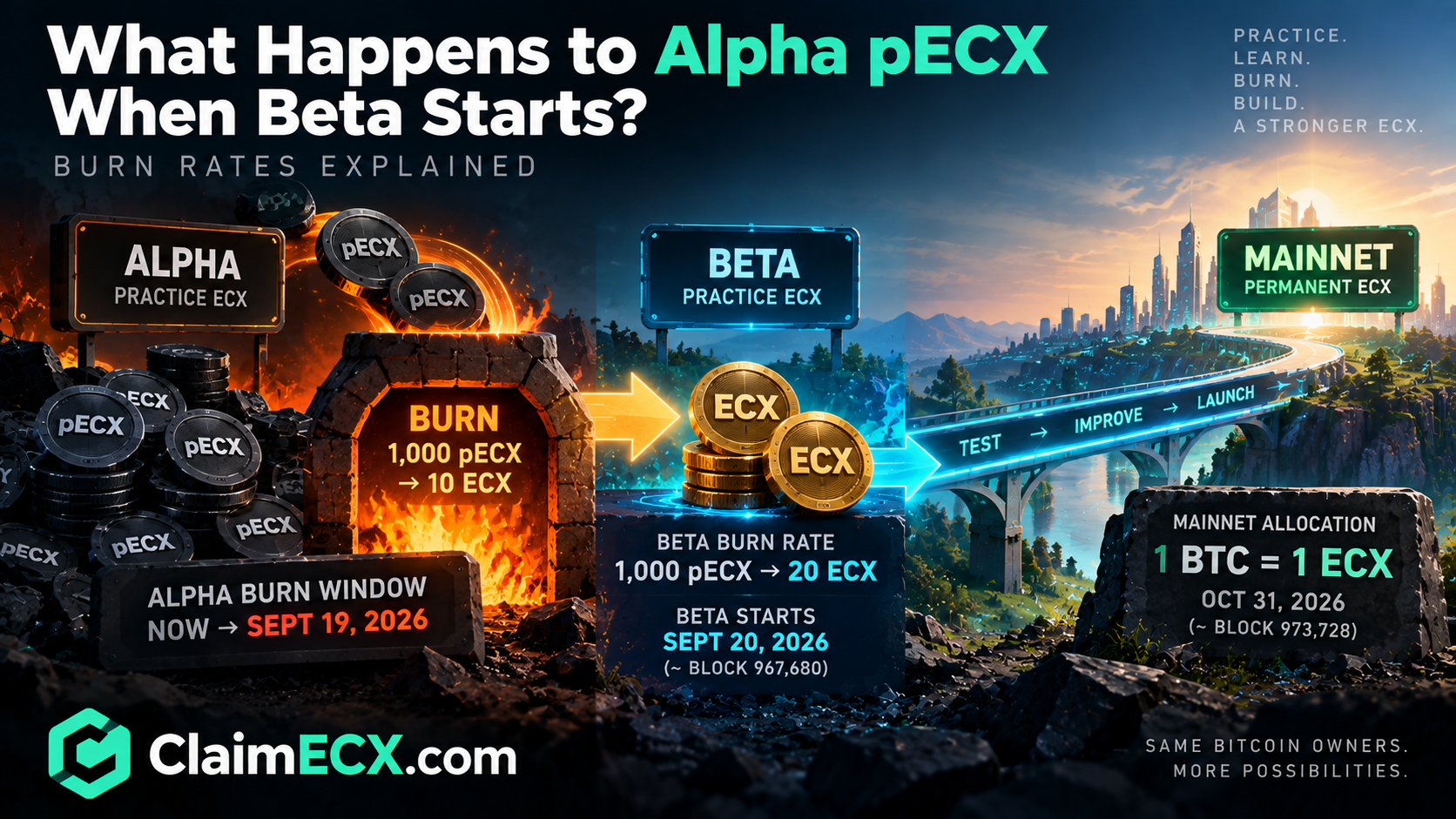
Alpha pECX is not permanent Mainnet ECX.
But it is also not a conventional testnet coin that users should automatically assume becomes meaningless when the next test stage begins.
The ECX launch plan gives practice ECX — usually called pECX — a specific redemption role. According to public launch information from the project, qualifying pECX can be burned under stage-specific rules in exchange for permanent ECX associated with the Mainnet launch.
The reported rates are different for Alpha and Beta:
| Stage | Practice asset | Reported burn rate | Stage timing |
|---|---|---|---|
| Alpha | pECX | 1,000 pECX → 10 ECX | Alpha burn window reported to close September 19, 2026 |
| Beta | pECX | 1,000 pECX → 20 ECX | Beta planned around September 20 / Bitcoin block 967,680 |
| Mainnet | Permanent ECX | Not a pECX stage | Planned around October 31 / Bitcoin block 973,728 |
The most important point is that this burn mechanism is separate from the planned 1 BTC = 1 ECX Mainnet allocation.
Burning practice ECX does not replace the Mainnet snapshot allocation described for eligible Bitcoin holders.
What Is pECX?
pECX means practice ECX.
It is the asset used during the Alpha and Beta stages of the ECX rollout.
These stages are designed to resemble the permanent network closely enough for miners, wallet developers, infrastructure operators and users to test real workflows before Mainnet.
That makes pECX useful for testing:
- wallet behavior;
- mining;
- transactions;
- coin splitting;
- replay protection;
- drivechain infrastructure;
- deposits and withdrawals;
- other ECX network operations.
But the distinction must remain clear:
Alpha/Beta pECX = practice-stage asset.
Mainnet ECX = permanent network asset.
For the broader network-stage comparison, see ECX Alpha vs Beta vs Mainnet: Which ECX Is Real?.
What Is the Alpha pECX Burn Rate?
The publicly stated Alpha conversion rule is:
1,000 Alpha pECX → 10 permanent ECX
This is a 100:1 pECX-to-ECX ratio, not a 1:1 conversion.
For example:
| Alpha pECX burned | ECX under the stated Alpha rate |
|---|---|
| 1,000 pECX | 10 ECX |
| 2,000 pECX | 20 ECX |
| 5,000 pECX | 50 ECX |
| 10,000 pECX | 100 ECX |
Public statements from the project also describe a minimum batch of 1,000 pECX for the redemption mechanism.
Users should therefore not interpret a displayed Alpha balance as an equal amount of permanent ECX.
Holding 1,000 Alpha pECX does not mean holding 1,000 Mainnet ECX.
Under the stated Alpha burn rule, the relevant redemption amount is 10 ECX.
When Does the Alpha Burn Window Close?
Public launch messaging states that the Alpha burn window closes September 19, 2026, immediately before the planned Beta stage.
Beta is scheduled to begin around September 20, 2026, at approximately Bitcoin block 967,680.
This makes the stage boundary important.
Users holding Alpha pECX should not simply assume that an Alpha practice balance automatically becomes a Beta balance or that an unused Alpha redemption opportunity remains available indefinitely.
The safer approach is to treat the Alpha and Beta stages as distinct environments with their own rules and deadlines.
Because these are launch-specific mechanics, users should verify the current official ECX software and project instructions before burning or moving pECX.
What Changes With Beta?
The most obvious reported change is the redemption rate.
For Beta, the stated rule is:
1,000 Beta pECX → 20 permanent ECX
That is twice the permanent ECX amount associated with the same quantity of pECX under the reported Alpha rate.
Example:
| Practice ECX | Alpha rate | Beta rate |
|---|---|---|
| 1,000 pECX | 10 ECX | 20 ECX |
| 2,000 pECX | 20 ECX | 40 ECX |
| 5,000 pECX | 50 ECX | 100 ECX |
| 10,000 pECX | 100 ECX | 200 ECX |
But this table needs an important qualification:
Alpha pECX and Beta pECX belong to different launch stages.
The better Beta rate should not be interpreted as evidence that users can simply carry Alpha pECX into Beta and redeem the same coins at the Beta rate.
The public launch information instead describes stage-specific practice coins and stage-specific burn mechanics.
Does Alpha pECX Automatically Become Beta pECX?
Users should not assume so.
Alpha and Beta start from different Bitcoin snapshot blocks and are separate practice stages.
The project has described the rollout as:
Alpha → Beta → Mainnet
with each stage intended to provide another live rehearsal of the eventual permanent launch.
That means an Alpha transaction history or Alpha balance should not be treated as though it automatically carries forward into Beta or Mainnet unless the official software and current launch documentation explicitly say so.
The burn mechanism is the relevant bridge described for practice ECX: qualifying pECX is burned under the applicable rules toward permanent ECX.
Can the Same Bitcoin Holder Participate in Alpha, Beta and Mainnet?
Public statements from project founder Paul Sztorc indicate that a Bitcoin holder can split at all three stages, subject to the applicable rules.
Conceptually, that means the stages serve different purposes:
- Alpha snapshot / practice stage — acquire and test Alpha pECX.
- Beta snapshot / practice stage — a new practice stage associated with the Beta snapshot.
- Mainnet snapshot — determines the permanent ECX allocation under the Mainnet rules.
This is another reason not to think of Beta as merely a continuation of an Alpha wallet balance.
Each stage references its own point in the Bitcoin chain.
Does Burning pECX Replace the 1:1 Mainnet Allocation?
No, according to the project's published launch messaging.
This is probably the most important distinction in the entire pECX system.
The pECX redemption mechanism has been described as additional to, not a replacement for, the planned Mainnet allocation.
The permanent Mainnet distribution is separately described as:
1 BTC = 1 ECX
for BTC associated with eligible addresses at the applicable Mainnet snapshot under the network's rules.
So there are two concepts:
Mainnet allocation
Based on the BTC balance at the permanent Mainnet snapshot.
Practice-stage redemption
Permanent ECX obtained through the stated burn mechanism for qualifying Alpha or Beta pECX.
They should not be combined into a single calculation.
A user does not need to sacrifice BTC in order to burn pECX, and burning practice ECX should not be described as converting Bitcoin into ECX.
Why Does Beta Have a Higher Burn Rate?
The project has presented Alpha and Beta as rehearsal stages leading toward the permanent launch.
A higher Beta burn rate gives the later practice stage a different incentive structure.
However, Claim eCash would not interpret the difference as a market price or guaranteed economic value for pECX.
The ratios are protocol/launch redemption rules.
They do not establish:
- a dollar value for pECX;
- a guaranteed ECX market price;
- exchange liquidity;
- an investment return;
- a guaranteed ability to sell either asset.
That distinction is particularly important when third-party services display prices or markets for practice ECX.
Why Burn pECX at All?
The purpose of pECX is broader than redemption.
Alpha has already been used to expose real network behavior involving mining difficulty, orphan blocks, enforcers, pools and drivechain infrastructure.
Read ECX Alpha Stress Test: What the Network Has Learned Before Beta for the technical lessons discovered during the Alpha stage.
The burn mechanism gives participants an additional reason to interact with the practice network seriously enough to test real workflows.
But pECX should still be understood first as a practice-stage asset.
The redemption feature does not turn Alpha or Beta into Mainnet.
What Should Alpha pECX Holders Do Before Beta?
There is no need to turn the stage transition into a race.
There is, however, a reason to understand the rules before the reported Alpha deadline.
Before taking action:
- Confirm which network you are using. Make sure the balance is Alpha pECX rather than Beta or Mainnet ECX.
- Verify the current burn instructions. Launch mechanics can change during testing, so use current official software/documentation.
- Check the applicable deadline. Public launch messaging states September 19 for the Alpha burn window.
- Understand the minimum. Public statements describe burns in batches of at least 1,000 pECX.
- Do not confuse pECX redemption with the Mainnet allocation. They are separate mechanisms.
- Protect your BTC credentials. A public-address eligibility check does not require a recovery phrase or private key.
If you are working with forked assets, also review ECX Replay Protection Explained before moving BTC or ECX.
Alpha → Beta → Mainnet: The Simple Version
The easiest way to understand the rollout is:
Alpha
Practice network. Practice pECX. Reported burn rate: 1,000 pECX → 10 ECX. Reported Alpha burn deadline: September 19.
↓
Beta
Second practice network. New practice-stage pECX. Planned around September 20 / block 967,680. Reported burn rate: 1,000 pECX → 20 ECX.
↓
Mainnet
Permanent ECX network. Planned around October 31 / block 973,728. Separate permanent allocation based on the Mainnet snapshot, described as 1 BTC = 1 ECX.
The key is not to collapse these three stages into one balance.
What Happens to Alpha pECX When Beta Starts?
The practical answer is:
Alpha pECX does not simply become permanent ECX when Beta begins.
It belongs to the Alpha practice stage and is subject to the Alpha redemption rules.
Public project messaging states that the Alpha burn window closes September 19 and that qualifying Alpha pECX can be burned at the stated 1,000 pECX → 10 ECX rate.
Beta then begins a new practice stage with a reported 1,000 pECX → 20 ECX burn rate.
Mainnet remains separate.
That is when permanent ECX launches and the planned 1:1 BTC-based Mainnet allocation becomes relevant.
For Bitcoin holders, the safest mental model is therefore:
practice first, redeem under the applicable stage rules, and keep the permanent Mainnet snapshot concept separate.