
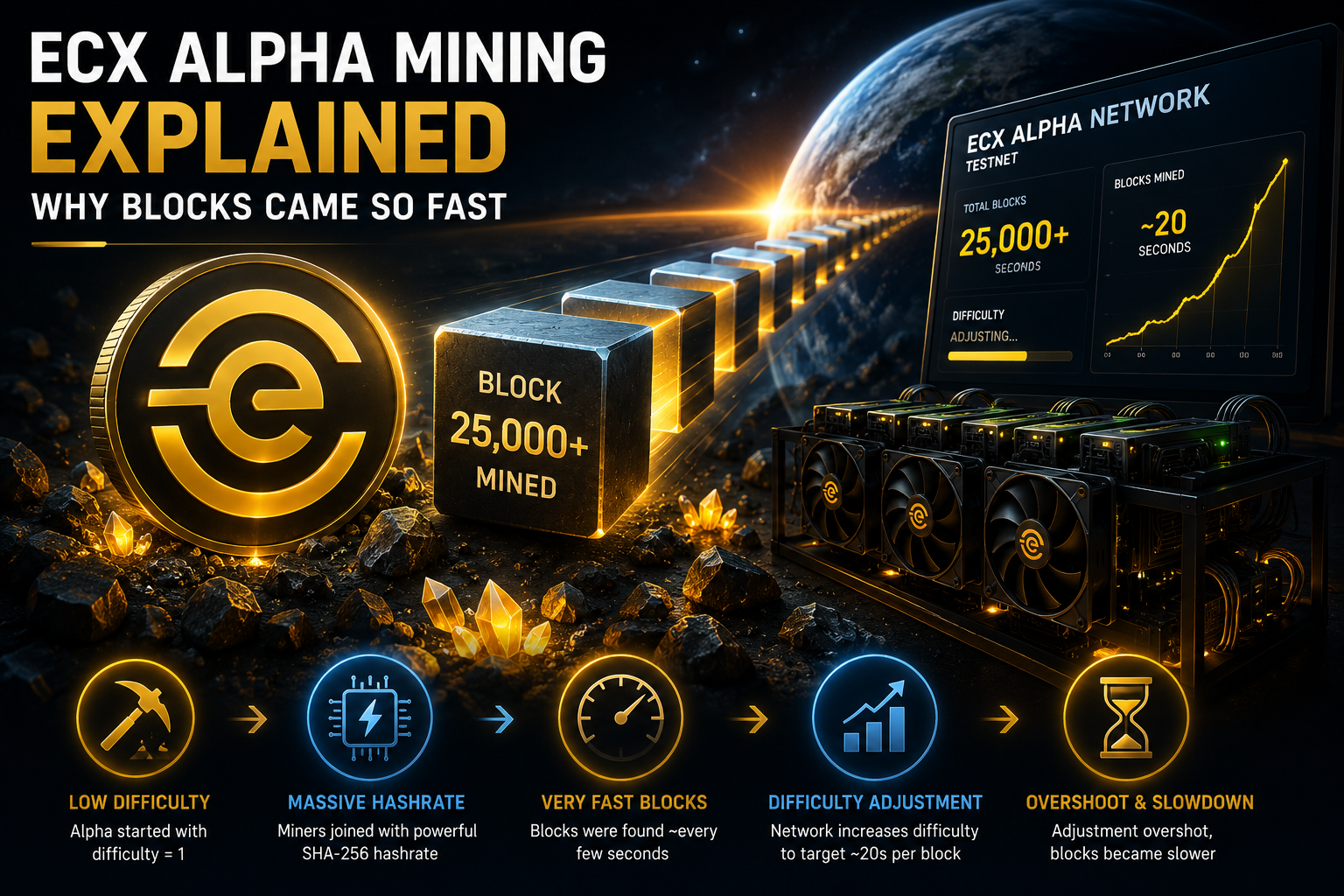
ECX Alpha launched and almost immediately began producing blocks at a pace that looked extraordinary.
Within roughly 13 hours, the chain had passed 25,000 blocks. Around 15 hours after launch, it was approximately 26,000 blocks ahead of Bitcoin, with tens of thousands of practice ECX already mined.
Bitcoin normally targets one block every 10 minutes.
So how could a Bitcoin-derived network produce tens of thousands of blocks in less than a day?
The answer is not that ECX was designed to permanently run thousands of times faster than Bitcoin.
It was the result of a test network starting at extremely low mining difficulty and suddenly attracting substantial SHA-256 hashrate.
Alpha then had to adjust.
That was part of the test.
For the broader launch-stage context, see ECX Alpha vs Beta vs Mainnet.
Quick Answer: Why Were ECX Alpha Blocks So Fast?
ECX Alpha began with mining difficulty set to 1. When real SHA-256 mining power arrived, that difficulty was far too low for the amount of hashrate competing for blocks.
Miners therefore found blocks extremely quickly.
As the network adjusted its mining difficulty upward, block production began moving toward more sustainable conditions.
By the end of the first day, reported Alpha difficulty had climbed to roughly 16.7 million.
In other words:
Low starting difficulty + significant SHA-256 hashrate = extremely fast early blocks.
The unusual block count was therefore a feature of the Alpha launch conditions, not evidence that permanent ECX is supposed to produce a block every few seconds.
ECX Alpha Started at Difficulty 1
Mining difficulty determines how difficult it is for miners to find a valid block.
The higher the difficulty, the more hashing work is statistically required.
ECX Alpha started at:
Difficulty: 1
That gave the new test network an intentionally accessible starting point.
But ECX uses SHA-256 proof-of-work infrastructure in an ecosystem where enormous amounts of specialized Bitcoin mining hardware already exist.
Once meaningful mining power was pointed at a network whose difficulty was still extremely low, the result was predictable:
blocks arrived very quickly.
The network then had to react to the actual mining power participating in Alpha.
Why Does Hashrate Change Block Speed?
A proof-of-work blockchain is essentially running a probability contest.
Miners repeatedly hash candidate block data, trying to produce a result that satisfies the network's current difficulty target.
If difficulty remains constant while more hashing power joins, valid blocks are found more frequently.
A simplified example:
- low hashrate + low difficulty → blocks may arrive near the expected pace.
- high hashrate + the same low difficulty → blocks arrive much faster.
- difficulty rises → block production slows again.
This relationship is why proof-of-work networks need difficulty adjustment.
Without it, a sudden increase or decrease in mining power could permanently distort block timing.
What Happened During the First Hours of ECX Alpha?
Alpha began around Bitcoin block 963,648.
Almost immediately, miners started extending the new chain.
During the first 30 minutes, thousands of Alpha blocks were reportedly produced.
Roughly 13 hours after launch, the chain had passed 25,000 blocks.
Around 15 hours after launch, it was approximately 26,000 blocks ahead of Bitcoin, with around 80,000 pECX reported as mined.
Those numbers look dramatic when compared with Bitcoin.
At Bitcoin's approximate 10-minute target, producing 25,000 blocks would ordinarily represent years of block production.
On Alpha, it happened in hours because the starting difficulty had not yet caught up with the available mining power.
Was ECX Alpha "Faster Than Bitcoin"?
Technically, blocks were being found much faster during the early Alpha period.
But describing ECX as simply "thousands of times faster than Bitcoin" would be misleading.
The two chains were operating under completely different mining conditions.
Bitcoin has an enormous established hashrate and a difficulty level calibrated around that mining environment.
ECX Alpha was a newly launched test chain beginning from a deliberately low difficulty.
The useful comparison is therefore not:
ECX is faster than Bitcoin.
It is:
ECX Alpha initially had far more mining power relative to its difficulty than the network target expected.
That is why the blocks accelerated.
Difficulty Quickly Started Climbing
The network did not remain at difficulty 1.
As Alpha observed the rate at which miners were producing blocks, difficulty increased sharply.
By the end of the first day, reported difficulty had reached approximately:
16.7 million
That enormous change illustrates what Alpha was doing in real time.
The network was moving from an artificial starting condition toward conditions shaped by actual miner participation.
This is one reason a live Alpha can reveal behavior that a private test environment may not.
Real miners have incentives.
They arrive and leave.
They redirect hashpower.
They react to profitability.
And the difficulty algorithm has to respond.
Hashrate Reached Serious Levels
ECX Alpha did not remain a tiny network mined only by a few hobbyists.
At one point during the second day, reported hashrate reached roughly 1 EH/s.
For a new practice network, that is substantial SHA-256 mining power.
Some of the activity was reportedly connected with rented hashrate sources such as Braiins and NiceHash.
That introduced another useful test.
A network does not only need to respond when mining power arrives gradually.
It also needs to respond when large amounts of hashrate appear suddenly — and then disappear.
The Other Side of Fast Blocks: Difficulty Overshoot
Fast blocks were only half of the story.
If difficulty rises in response to a sudden surge of hashrate and that hashrate later leaves, the network can be left with difficulty that is temporarily too high for the remaining miners.
Then the opposite happens:
blocks become slow.
This is often described as a difficulty overshoot.
Alpha reportedly experienced this pattern after bursts of rented mining power.
The sequence was roughly:
low difficulty → hashrate arrives → blocks accelerate → difficulty rises → hashrate leaves → blocks slow down
That is much more informative for developers than a testnet where mining power remains perfectly stable.
Why Was This Useful?
Alpha was not intended to demonstrate a perfectly mature permanent network on day one.
It was intended to expose problems before Mainnet.
Rapidly changing mining conditions tested several important parts of the system:
- difficulty adjustment.
- miner behavior.
- block-template generation.
- mining pool compatibility.
- chain synchronization.
- wallet rescanning.
- interaction with Drivechain infrastructure.
Alpha also exposed bugs and operational issues, including consensus halts, orphaned block-template problems, enforcer synchronization loops, wallet rescan problems and pool template mismatches.
That is exactly the kind of information a rehearsal is supposed to produce.
Were the 25,000 Blocks Permanent ECX?
No.
ECX Alpha uses practice ECX, commonly described as pECX.
Alpha is not the permanent Mainnet.
The unusually rapid mining activity therefore should not be interpreted as tens of thousands of permanent ECX Mainnet blocks being created ahead of launch.
The launch is structured in stages:
Alpha → testing
Beta → further testing and rehearsal
Mainnet → permanent ECX network
This distinction is important whenever Alpha mining statistics are discussed.
A block, balance or market experiment on Alpha is evidence about the test network.
It is not automatically a permanent Mainnet asset or Mainnet condition.
Did Fast Mining Change Bitcoin?
No.
ECX Alpha block production did not make Bitcoin produce blocks faster.
After the fork point, Bitcoin and eCash are separate chains.
Bitcoin continued operating under Bitcoin's own consensus rules, difficulty and miner environment.
ECX Alpha developed its own chain state independently.
The fact that Alpha became tens of thousands of blocks ahead therefore did not mean it had somehow accelerated the Bitcoin blockchain.
It simply meant Alpha had produced many more blocks on its own chain since the shared historical point.
Did Fast Blocks Change the ECX Snapshot?
No.
The relevant Bitcoin snapshot is based on Bitcoin's blockchain state at the designated snapshot block.
Rapid Alpha mining after the fork does not rewrite which Bitcoin addresses held BTC at that snapshot.
For holders, the important distinction is:
snapshot eligibility is determined from Bitcoin history;
Alpha mining activity happens afterward on the new chain.
If you want to inspect whether a public Bitcoin address is associated with an ECX allocation, use the ECX Claim Checker.
The checker only requires a public BTC address.
Does More Mining Mean More ECX for Bitcoin Holders?
Not in the sense of changing the snapshot allocation.
The ECX allocation associated with eligible BTC is determined by the fork's distribution rules.
Mining is a separate mechanism that creates block rewards and secures the new chain.
So there are two different concepts:
Snapshot allocation\ ECX associated with eligible BTC ownership at the snapshot.
Mining rewards\ Coins earned by miners for producing valid blocks.
Fast Alpha mining does not multiply the ECX allocation of a Bitcoin holder simply because more blocks were produced.
Why Alpha Matters Before Mainnet
The most important lesson from the first 25,000 Alpha blocks is not the number itself.
It is what happened when a new Bitcoin-derived network met real economic actors.
Miners found the low difficulty.
Hashpower arrived.
Blocks accelerated.
Difficulty responded.
Some hashpower disappeared.
Block timing changed again.
Software encountered real-world edge cases.
Developers and users then had concrete problems to investigate before the permanent network.
That is the value of the staged launch.
Instead of discovering every mining, wallet and infrastructure problem for the first time on Mainnet, ECX can expose them while the coins and network are still explicitly in a practice stage.
Alpha Was a Stress Test, Not a Speed Record
Seeing more than 25,000 blocks in around 13 hours makes for an impressive headline.
But treating it as an ECX performance benchmark misses the point.
The early speed primarily demonstrated a mismatch between starting difficulty and incoming hashrate.
What matters more is what happened next.
The network's mining environment changed dramatically, difficulty climbed by millions of times from its starting point, substantial SHA-256 hashrate participated, and the test exposed both fast-block and slow-block conditions.
Those are useful observations ahead of Beta and Mainnet.
ECX Alpha was not trying to win a race against Bitcoin's block height.
It was trying to find problems before they mattered permanently.
Check Your ECX Allocation
Mining ECX and receiving ECX through the Bitcoin snapshot are different things.
You do not need to mine ECX to check whether your Bitcoin address has an allocation.
Use the ECX Claim Checker with your public Bitcoin address.
No private key or recovery phrase is required for the eligibility check.