
ECX Alpha was never meant to be the permanent ECX network.
It is a practice stage: an environment where miners, wallets, pools, drivechains and supporting infrastructure can interact under real network conditions before Beta and, eventually, Mainnet.
That distinction matters more now than it did at launch.
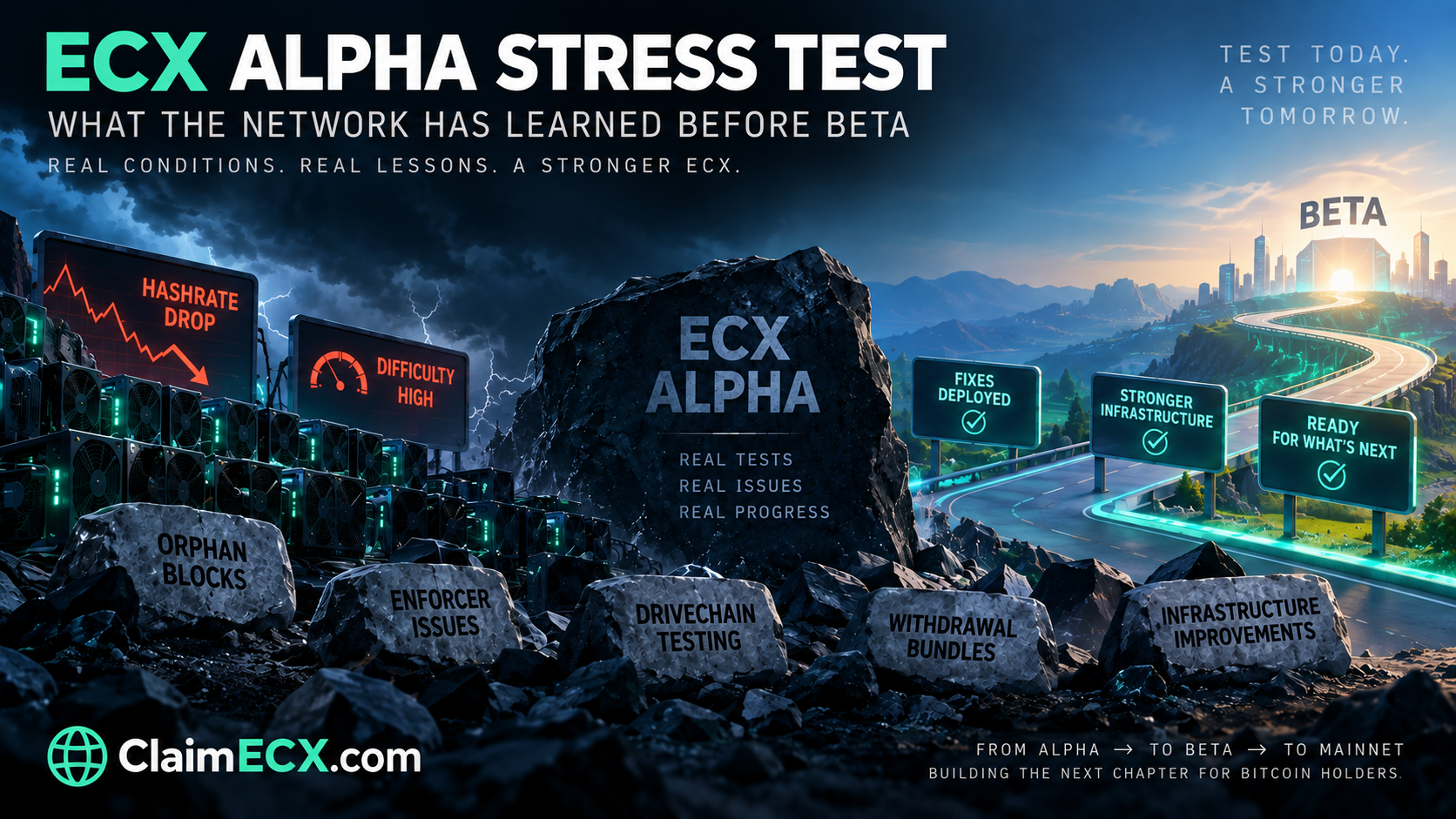
During the first weeks of Alpha, the network encountered slow block production, orphaned blocks, mining-pool and enforcer edge cases, drivechain activation tests and the first withdrawal-bundle experiments on a live BIP300 network.
Some of those tests failed.
That is precisely what makes them useful.
The important question before ECX Beta is not whether Alpha ran without problems. It did not. The better question is what Alpha has already exposed while the ECX being used remains practice ECX rather than permanent Mainnet ECX.
Alpha Moved From Launch to Stress Test
The first days of a new network mainly answer one question: can it start?
The following weeks ask harder questions.
What happens when temporary mining power disappears? What happens when a pool produces something its enforcer considers invalid? How does infrastructure respond to competing chain states? Can independent participants activate drivechains? What happens when withdrawal mechanisms encounter unexpected timing conditions?
Alpha has now started producing answers to those questions.
A detailed account of Alpha activity covering August 26 through September 7 documents several problems that surfaced under live conditions rather than in simulations. These included difficulty and hashrate instability, orphan-block incidents and edge cases involving BIP300 infrastructure.
For a practice network, these are valuable findings.
The Hashrate Hangover: When Mining Power Disappears
One of the clearest early lessons came from mining.
Alpha initially experienced bursts of rented SHA-256 hashpower. When some of that temporary mining power left, however, the difficulty it had helped produce did not disappear with it.
The result was a mismatch:
difficulty remained relatively high while available hashrate fell.
The Alpha chronology reports that by August 27 network difficulty was around 4.29G, with an estimated 30.7 PH/s required to maintain approximately ten-minute blocks while the network was operating at roughly 5 PH/s.
Block intervals subsequently stretched from around 90 minutes into multi-hour gaps. At one point, the chronology records an approximately eight-hour interval between blocks. Difficulty eventually adjusted downward on August 30.
This does not mean ECX suddenly stopped functioning permanently. It demonstrates a familiar challenge for smaller proof-of-work networks: large changes in hashrate can temporarily interact badly with difficulty adjustment.
More importantly, Alpha made that behavior observable before Mainnet.
It also generated discussion around whether alternative difficulty-adjustment mechanisms would handle sharp hashrate changes differently. Those discussions should not be confused with confirmed changes to ECX consensus rules, but Alpha supplied real data for evaluating the issue.
Block 996403: Ten Orphaned Blocks and a Useful Failure
A more specific incident occurred around Alpha block 996403.
According to the published Alpha account, a mining pool produced block 996403 containing a malformed M8 withdrawal request.
The pool's BIP300 enforcer rejected the block as invalid. Bitcoin Core, however, continued using the affected template, and the pool continued mining on a branch that the enforcer would not accept.
The result was 10 orphaned blocks over nearly three hours before another pool extended the valid chain and the affected infrastructure returned to the accepted chain.
This is exactly the kind of incident Alpha is useful for.
It was not merely a theoretical BIP300 discussion. A real pool, real miners and real software components interacted in an unexpected way and exposed a failure mode involving the relationship between the mining template and the enforcer.
The incident was subsequently documented in a public post-mortem. The Alpha account also reports that affected miners were reimbursed a combined 31.54250608 ECX across 38 addresses within three days.
For Mainnet preparation, the reimbursement is less important than the technical lesson:
software components can individually behave as designed and still produce an undesirable system-level result when their states diverge.
That is difficult to discover from specifications alone.
A Second Orphan-Block Problem Exposed Another Edge Case
Block 996403 was not the only orphan-block event described during Alpha.
A separate race condition involving enforcer error handling reportedly caused nodes to invalidate a valid block near height 987358 and regress through earlier blocks.
The most extreme consequence cited in the Alpha chronology was NurseryPool encountering 89 consecutive orphan blocks at the same height before fixes were introduced.
Again, this is not evidence that every ECX node experienced 89 orphan blocks or that this represents normal network operation.
It was a specific failure condition.
That distinction is important.
Claim eCash treats Alpha incidents as test-network observations rather than as evidence either for or against the future reliability of ECX Mainnet.
What matters before Beta is whether such conditions are identified, understood and addressed.
Enforcer Performance Improved During the Same Period
Alpha did not only reveal problems.
Infrastructure also changed as testing continued.
The same account reports substantial improvements in enforcer synchronization performance. By the end of the period, one reported test synchronized 963,649 blocks in under two minutes, compared with much slower synchronization earlier in Alpha.
A single benchmark should not be treated as a universal performance guarantee.
But it demonstrates another purpose of staged deployment: Alpha creates an environment where performance bottlenecks can be found and software can be iterated before the permanent network.
Drivechains Started Facing Real Proof-of-Work Conditions
Perhaps the most important development beyond the ECX base chain was happening on the drivechain layer.
ECX is not simply another Bitcoin fork with a different ticker. Its central technical experiment is the deployment of BIP300/301 drivechains.
Alpha therefore needs to test more than block production.
It needs to test whether drivechains can actually be proposed, acknowledged, mined and used under proof-of-work conditions.
During the period reviewed, Elements+ and FreeBank were reported as the first drivechains proposed by independent community participants to activate under proof of work on the Alpha network.
That is significant because it moves the system beyond drivechains operated only by the original development team.
Other experimental chains were proposed or placed into development as well.
The important point is not how many Alpha drivechains ultimately survive.
It is that the permissionless activation process itself is now being exercised by participants outside the core project.
The First Live Withdrawal-Bundle Experiment Found Another Bug
Alpha also reached another BIP300 milestone.
CoinShift produced what the source describes as the Alpha network's first M8 and subsequently the first withdrawal bundle proposal mined on a live drivechain network.
That experiment also found a problem.
Nodes reportedly crashed when the M3 withdrawal bundle proposal was mined more than one block late.
From a Mainnet perspective, the interesting part is not the milestone by itself.
It is the combination:
new protocol path exercised → unexpected condition encountered → bug becomes reproducible → fix can be developed before permanent ECX.
That is what a useful test environment should produce.
Alpha Is Also Testing the Infrastructure Around ECX
A blockchain does not operate in isolation.
Explorers, pools, wallets, enforcers, faucets and other services all need to agree about what the network is doing.
Alpha has exposed problems at this layer as well.
For example, the Alpha chronology reports that the primary explorer temporarily displayed an orphaned ePool block as canonical because the explorer was not enforcer-aware.
The underlying chain and the interface used to observe the chain are different systems.
For users, however, that distinction can be invisible.
An explorer showing the wrong chain state can create confusion even when consensus itself is behaving differently.
Finding these discrepancies during Alpha gives infrastructure providers time to make their software aware of ECX-specific consensus behavior before Mainnet balances become permanent.
What Has Alpha Actually Taught Us?
The first weeks provide several concrete lessons.
1. Hashrate volatility matters. Large temporary increases in mining power can leave a smaller network operating at an uncomfortable difficulty after that hashpower leaves.
2. BIP300 adds new integration surfaces. Bitcoin Core, mining software and the enforcer must maintain compatible views of valid chain state.
3. Orphan handling needs real-world testing. The incidents around blocks 996403 and 987358 exposed conditions that are difficult to appreciate from protocol documentation alone.
4. Drivechains need miners, not just code. Proposals, acknowledgements, BMM and withdrawal bundles have to work through actual mining infrastructure.
5. Supporting infrastructure matters. An explorer, wallet or pool can introduce user-facing problems even when the underlying protocol is operating differently.
6. Alpha problems are not automatically Mainnet problems. Alpha exists specifically so that bugs, edge cases and operational assumptions can be challenged before the permanent network launches.
What This Means for Bitcoin Holders
For someone primarily interested in claiming ECX from Bitcoin holdings, most of these engineering details do not require immediate action.
The most important distinction remains:
ECX Alpha is not permanent ECX Mainnet.
Alpha balances are practice balances associated with the Alpha stage. Beta will be another practice stage. Mainnet is the permanent network.
Bitcoin holders therefore should not interpret an Alpha balance, Alpha transaction, Alpha mining reward or Alpha network incident as if it occurred on permanent ECX Mainnet.
The staged rollout exists precisely to separate these environments.
For a detailed comparison, see ECX Alpha vs Beta vs Mainnet: Which ECX Is Real?.
What to Watch as ECX Beta Approaches
The useful question now is whether the lessons from Alpha carry forward.
Before and during Beta, several areas deserve attention:
- stability of mining and difficulty behavior;
- fixes related to previously observed enforcer edge cases;
- pool adoption of BIP300-aware infrastructure;
- reliability of explorers and other network observers;
- drivechain activation and BMM behavior;
- deposit and withdrawal-bundle testing;
- wallet and coin-splitting reliability.
Beta should not be judged by whether nothing goes wrong.
A test network that never reaches difficult conditions may teach very little.
A better measure is whether previously observed problems become harder to reproduce, new problems are documented clearly, and the infrastructure becomes more reliable as the permanent launch approaches.
Alpha Is Doing the Job a Practice Network Is Supposed to Do
The most useful result from ECX Alpha so far is not a block count, mining rate or number of drivechains.
It is information.
Alpha has already produced real examples of difficulty stress, orphaned blocks, enforcer behavior, pool integration problems, drivechain activation and withdrawal-bundle edge cases.
Some of those examples are messy.
That is not something Claim eCash should hide.
It is the reason separating Alpha, Beta and Mainnet matters in the first place.
Alpha gives the ECX ecosystem a place to discover what happens when assumptions meet a live network while the coins involved are still practice ECX.
Beta will provide the next test.
Mainnet is where those lessons begin to matter permanently.