
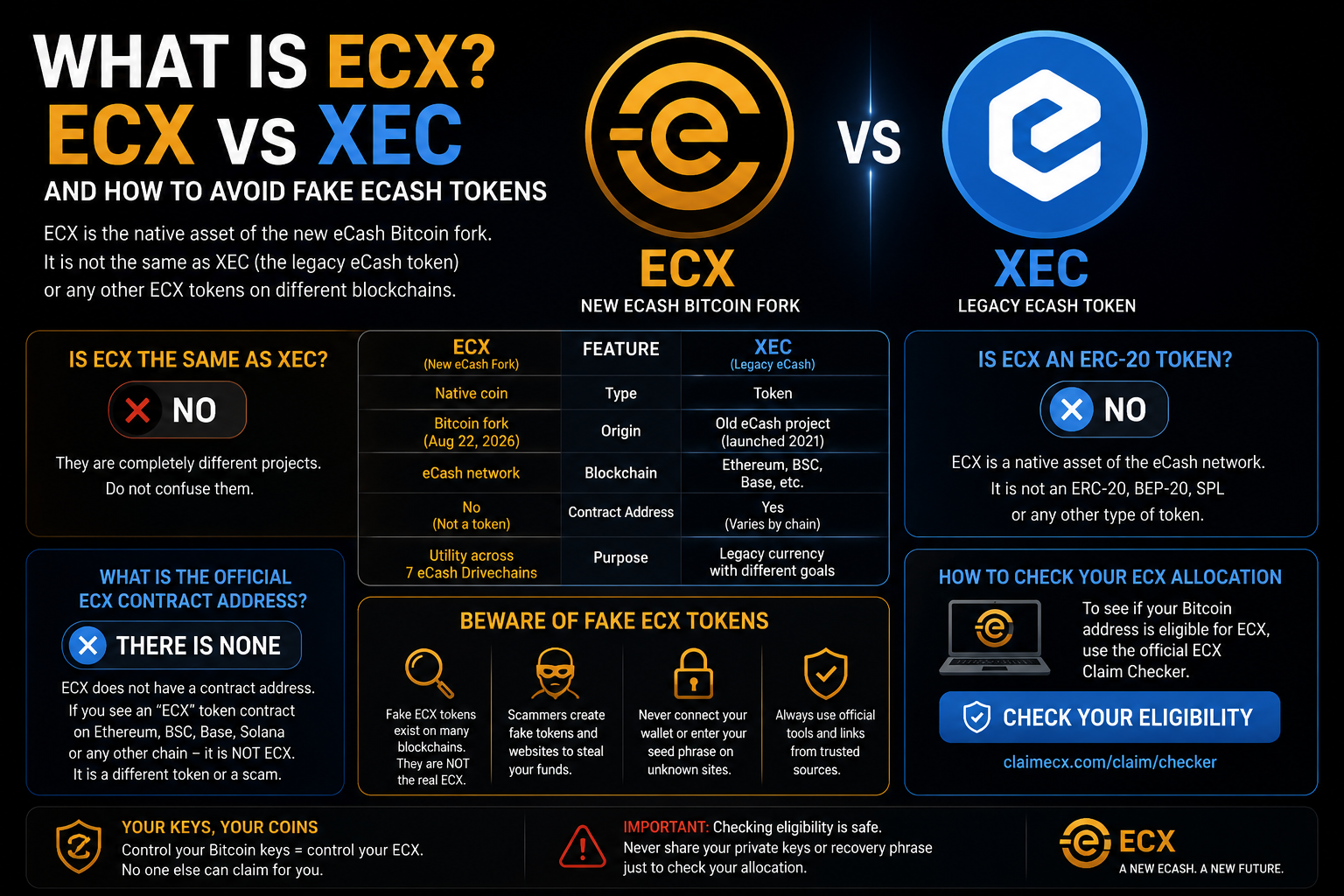
Search for eCash today and you can easily find information about two completely different cryptocurrency projects.
One uses the ticker XEC.
The other uses ECX.
They are not the same coin, they do not run on the same blockchain, and owning one does not give you the other.
There is another layer of confusion as well: ECX is launching through Alpha, Beta and Mainnet stages, so users may also encounter practice ECX (pECX) before permanent ECX exists on Mainnet.
And wherever a new cryptocurrency, fork or distribution attracts attention, misleading tokens, fake wallet pages and phishing attempts can appear.
This guide explains the difference between ECX, XEC and pECX, what the real ECX network is, and what to check before interacting with anything claiming to be an ECX token, wallet or claim service.
Quick Answer: Is ECX the Same as XEC?
No. ECX and XEC are different cryptocurrencies on different blockchain networks.
ECX is the ticker used by the new eCash Bitcoin hard fork built around Drivechains. Its permanent Mainnet is planned to begin from the Bitcoin ledger at the Mainnet activation block, with eligible Bitcoin addresses receiving ECX according to the network's distribution rules.
XEC is the ticker of the existing eCash project that originated from Bitcoin Cash ABC and adopted the eCash name in 2021.
The similar names can be confusing, but the assets are unrelated.
If you are trying to determine whether a Bitcoin address is eligible for the new Bitcoin-derived ECX, buying or holding XEC does not provide that eligibility.
What Is ECX?
ECX is the native asset of the new eCash blockchain derived directly from Bitcoin.
The network is designed to activate Drivechain functionality and is launching in three stages:
Stage Purpose Asset ————- ——————————- ————-- Alpha Early live testing Practice ECX Beta Further rehearsal and testing Practice ECX Mainnet Permanent network ECX
The current roadmap lists:
- Alpha: August 23, 2026, around Bitcoin block 963,648
- Beta: September 20, 2026, around Bitcoin block 967,680
- Mainnet: October 31, 2026, around Bitcoin block 973,728
At Mainnet, the network plans to credit permanent ECX to eligible Bitcoin addresses at a 1 BTC = 1 ECX ratio according to the fork rules.
Your Bitcoin is not converted into ECX.
If an address holds BTC on Bitcoin, the BTC remains on the Bitcoin network. ECX exists separately on the eCash blockchain.
That distinction is fundamental:
BTC remains BTC. ECX is a separate asset on a separate chain.
What Is XEC?
XEC is also called eCash, but it belongs to a different project.
The existing XEC network developed from the Bitcoin Cash ABC lineage and adopted the eCash brand in 2021.
Its history is therefore different from the new ECX chain.
A simplified lineage looks like this:
Bitcoin → Bitcoin Cash → Bitcoin Cash ABC → eCash (XEC)
The new ECX project follows a different path:
Bitcoin → eCash (ECX)
That difference in origin is one of the easiest ways to understand why the two assets should not be treated as versions of the same coin.
ECX vs XEC: The Difference at a Glance
| Question | ECX | XEC |
|---|---|---|
| Project | New eCash Bitcoin hard fork | Existing eCash network |
| Blockchain | ECX/eCash fork network | XEC network |
| Bitcoin snapshot allocation | Yes, according to ECX launch rules | No |
| Same asset? | No. ECX and XEC are different cryptocurrencies. | |
The shared name is the confusing part.
The ticker and blockchain are what matter.
Does Buying XEC Give You ECX?
No.
Buying XEC does not create an ECX allocation.
The planned ECX distribution is based on Bitcoin balances under the ECX network's snapshot and fork rules.
That means ECX eligibility is connected to BTC ownership at the relevant Bitcoin snapshot, not to ownership of XEC.
This is particularly important because search results, exchange pages and market-data websites may already show an asset called eCash when users search for ECX.
Always check the ticker.
XEC is not ECX.
What Is pECX?
There is one more name users need to understand.
During the Alpha and Beta stages, the eCash network uses practice ECX, often referred to as pECX.
These stages exist so miners, developers, wallets and users can test the network before permanent Mainnet.
Practice ECX should therefore not be confused with permanent Mainnet ECX.
The distinction is:
ECX Alpha / Beta → practice environment
ECX Mainnet → permanent network
The project describes a mechanism under which practice ECX from the test stages can be burned toward permanent ECX under its launch rules, but that does not make Alpha or Beta balances identical to permanent Mainnet ECX.
If a service presents an Alpha pECX balance as though it were already a permanent Mainnet ECX balance, investigate carefully before acting.
ECX, XEC and pECX Are Three Different Labels
For someone encountering the ecosystem for the first time, the easiest mental model is:
ECX
The permanent native asset planned for the new Bitcoin-derived eCash Mainnet.
pECX
Practice ECX used during the Alpha and Beta testing stages.
XEC
An existing, separate cryptocurrency that also uses the eCash name.
Mixing these labels can lead to more than a harmless ticker mistake.
It can lead users to the wrong wallet, wrong blockchain, wrong exchange market or a fraudulent token.
Is ECX an ERC-20 Token?
No.
The ECX described in this guide is the native asset of its own Bitcoin-derived blockchain.
It is not an ERC-20 token on Ethereum.
It is not a Solana token.
It is not a Base token.
That means users should be extremely cautious if they encounter a token on an unrelated smart-contract network using the name ECX or eCash and presenting itself as the Bitcoin-fork asset.
A token can use the same ticker without being the same asset.
Ticker symbols are not globally unique identifiers.
What Is the Official ECX Contract Address?
For the native ECX asset discussed here, asking for an Ethereum, Base or Solana-style contract address is the wrong model.
ECX is intended to exist as the native coin of the eCash blockchain rather than as a token contract deployed on another network.
So if someone tells you that you must buy the "real ECX" by importing a random contract address into a wallet on Ethereum, Base, Solana or another unrelated chain, do not assume that token represents the Bitcoin-derived ECX.
The safest question is not:
"Does the ticker say ECX?"
It is:
"Which blockchain is this asset actually on?"
Fake ECX Tokens Can Use the Correct Ticker
A scam or unrelated token does not need to invent a different name.
Anyone deploying a token on a permissionless smart-contract network may be able to choose a familiar ticker.
That means a token displaying:
ECX
or
eCash
is not automatically connected to the actual ECX Bitcoin fork.
This is why verification must include the network, not just the symbol.
Before interacting with an ECX asset, ask:
- Which blockchain is it on?
- Is it native ECX or a token issued on another chain?
- Does the information match the ECX network's published launch structure?
- Are you being asked to connect a wallet or reveal credentials unnecessarily?
If those answers do not make sense, stop before signing or sending anything.
A Public Address Is Enough to Check ECX Eligibility
One of the easiest ways to reduce risk is to separate checking eligibility from claiming or moving coins.
To determine whether a Bitcoin address has an ECX allocation, you do not need to expose the private credentials controlling that Bitcoin.
The ECX Claim Checker uses a public Bitcoin address to check eligibility and allocation information.
A public BTC address cannot be used to spend the Bitcoin in that wallet.
For a basic eligibility check, you should not need to provide:
- your Bitcoin private key.
- your recovery phrase.
- your seed phrase.
- your wallet password.
This distinction is one of the most important security rules for Bitcoin-fork holders.
Checking whether an address is eligible should not require giving anyone control of the address.
Never Enter a Seed Phrase Just to "Check" ECX
A website may claim:
Connect your wallet to see your ECX.
Or:
Enter your recovery phrase to verify your allocation.
That should immediately raise concern if the only task is checking eligibility.
A seed phrase or private key can provide control over wallet funds.
A public address does not.
If you simply want to know whether a BTC address qualifies for an ECX allocation, start with the public address.
Only consider any key-sensitive process when you intentionally reach the actual claim or wallet-import stage, understand exactly why the key is required, and have verified the software and procedure you are using.
See the ECX claim security guide before taking that step.
The separate ECX replay protection article explains why checking an address and spending forked coins are different safety steps.
Fake Claim Sites Are a Different Risk From Fake Tokens
There are two separate problems users should watch for.
Fake ECX Token
An unrelated asset uses the ECX or eCash name on another blockchain.
The objective may be to attract buyers who believe they are purchasing the Bitcoin-derived ECX.
Fake ECX Claim Site
A website pretends to help Bitcoin holders receive ECX but attempts to obtain wallet credentials or trick users into signing dangerous transactions.
The first attacks your understanding of the asset.
The second attacks your wallet.
The defense against both begins with verification.
Five Checks Before You Interact With Anything Called ECX
1. Check the ticker
The Bitcoin-derived asset discussed here is ECX, not XEC.
2. Check the blockchain
Native ECX belongs to the eCash blockchain.
Do not assume an ECX token on Ethereum, Solana, Base or another unrelated network is the same asset.
3. Check the network stage
Alpha and Beta use practice ECX.
Permanent ECX belongs to Mainnet.
4. Check what information the site requests
A public BTC address is sufficient for an eligibility check.
A request for a seed phrase or private key during a simple eligibility check is a major warning sign.
5. Check before you sign
Do not approve wallet transactions simply because a website displays the ECX name or logo.
Understand what network you are using and what the transaction will actually do.
What If a Website Shows an ECX Price?
Treat the context carefully.
During Alpha and Beta, experimental markets may exist for practice assets, and unrelated tokens can also trade under similar symbols.
A displayed "ECX price" therefore does not automatically mean you are looking at a market for permanent Mainnet ECX.
Verify:
- the network.
- whether the asset is practice or permanent ECX.
- the trading venue.
- the actual asset being quoted.
- whether permanent Mainnet has launched.
A ticker alone is not enough.
This becomes especially important when search engines and market pages mix information about ECX and XEC.
Why the ECX vs XEC Confusion Matters
Normally, confusing two ticker symbols is inconvenient.
Here it can become a security issue.
Someone who searches for an "eCash wallet" without checking the ticker could end up using software designed for XEC rather than ECX.
Someone searching for an "ECX contract address" could discover an unrelated token.
Someone expecting permanent ECX during Alpha could misunderstand the value or purpose of practice coins.
And someone searching for an ECX claim could encounter a page designed to steal a recovery phrase.
Understanding the naming problem is therefore part of safely interacting with the fork.
How to Verify Your Actual ECX Allocation
If your goal is simply to determine whether a Bitcoin address is associated with ECX, you do not need to begin by searching exchanges, token contracts or wallet-connect pages.
Start with the Bitcoin address itself.
Use the ECX Claim Checker.
Enter the public BTC address.
Review the available snapshot and allocation information.
Then, if you decide to proceed beyond eligibility checking, read how to claim ECX and the security instructions before using any private wallet credentials.
The order matters:
Verify first. Claim second. Move coins only when you understand the process.
The Simple Rule: Verify the Chain, Not Just the Name
The word eCash is no longer enough to identify a cryptocurrency.
Neither is a logo.
And in an open cryptocurrency ecosystem, even a ticker can be copied.
The reliable distinction is the underlying network.
Remember:
XEC is the existing eCash cryptocurrency from the Bitcoin Cash ABC lineage.
pECX refers to practice ECX used during the Alpha and Beta stages of the new fork.
ECX is the permanent native asset planned for the new Bitcoin-derived eCash Mainnet.
And a random token called ECX on an unrelated blockchain is not automatically any of those things.
When in doubt, verify the blockchain before you buy, send, sign or enter wallet credentials.
Check Your ECX Eligibility Safely
If you held BTC at an applicable ECX snapshot and want to check whether your Bitcoin address has an associated allocation, begin with a public-address lookup.
Only a public Bitcoin address is required for the eligibility check.
Never provide a private key or recovery phrase merely to find out whether your address is eligible.