
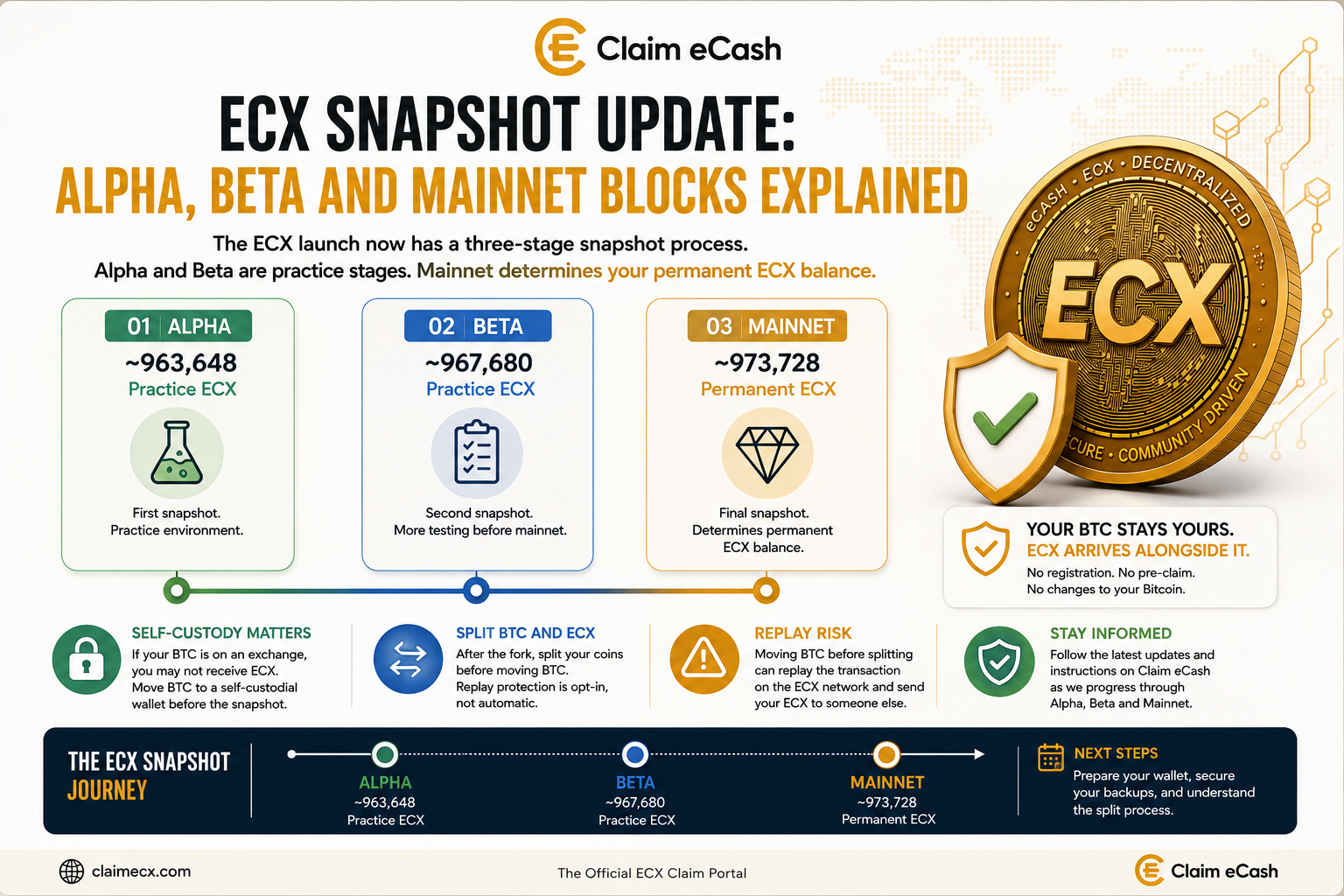
The eCash (ECX) launch process now has a more detailed three-stage structure across Alpha, Beta and Mainnet.
For Bitcoin holders, the most important change is that the previously referenced Bitcoin block ~963,648 is the Alpha snapshot, not the final snapshot that determines permanent ECX balances.
The updated snapshot schedule is:
| Stage | Approx. Bitcoin Block | ECX Balance |
|---|---|---|
| Alpha | ~963,648 | Practice ECX |
| Beta | ~967,680 | Practice ECX |
| Mainnet | ~973,728 | Permanent ECX |
Alpha and Beta are practice stages. The Mainnet snapshot at approximately Bitcoin block ~973,728 is the stage associated with permanent ECX balances.
What Changed?
Earlier information about the ECX fork focused on an upcoming snapshot around Bitcoin block ~963,648.
The updated launch structure provides additional detail. Rather than treating this block as the single final snapshot for permanent ECX, the ECX launch now progresses through three stages: Alpha, Beta, and Mainnet.
- Bitcoin block ~963,648 represents Alpha.
- Bitcoin block ~967,680 represents Beta.
- Bitcoin block ~973,728 represents Mainnet.
The distinction is important because ECX balances associated with Alpha and Beta are practice ECX, while the Mainnet stage establishes the permanent ECX balance.
Alpha Snapshot - Block ~963,648
The first stage is the Alpha snapshot, expected around Bitcoin block ~963,648.
Bitcoin addresses holding BTC at this stage receive a corresponding practice ECX balance for the Alpha environment.
Alpha is part of the ECX launch and testing process, but its ECX balances should not be confused with permanent Mainnet ECX.
Beta Snapshot - Block ~967,680
The second stage is the Beta snapshot, expected around Bitcoin block ~967,680.
Like Alpha, the Beta snapshot creates practice ECX balances.
The Beta stage provides another pre-Mainnet environment before the permanent ECX network state is established.
Users following their ECX allocation during these stages should therefore distinguish between an Alpha or Beta balance and a permanent Mainnet balance.
Mainnet Snapshot - Block ~973,728
The third and most important stage for permanent ECX is the Mainnet snapshot, expected around Bitcoin block ~973,728.
This is the snapshot associated with permanent ECX balances.
Bitcoin addresses holding BTC at the Mainnet snapshot receive the corresponding balance on the eCash network according to the fork's distribution rules.
Users interested in permanent ECX should therefore treat the Mainnet snapshot, rather than Alpha or Beta, as the critical final snapshot stage.
Your Bitcoin Remains Bitcoin
The ECX snapshot does not convert your Bitcoin into ECX.
Your BTC is not exchanged, transferred, burned, or removed from the Bitcoin network as part of the snapshot.
Instead, the fork creates a separate ECX balance based on Bitcoin's existing ledger at the relevant snapshot.
BTC
Remains on the Bitcoin network.
ECX
Exists separately on the eCash network.
Receiving ECX does not require giving up your BTC.
No Registration or Pre-Claim Is Required for the Snapshot
The snapshot itself is based on the Bitcoin ledger.
There is no registration or pre-claim required for a Bitcoin address to be included in the snapshot.
The relevant factor is the BTC balance associated with the address when the applicable snapshot occurs.
However, being included in a snapshot and being able to independently access the corresponding ECX are not exactly the same thing. Who controls the Bitcoin wallet matters.
Why Self-Custody Matters
If you want direct control over the ECX associated with your BTC, self-custody is important.
When BTC is held in a self-custodial wallet, you control the wallet credentials required to manage the assets associated with your addresses.
If your BTC is held on an exchange or another custodial platform at the time of the fork, you do not necessarily control the corresponding ECX.
Whether ECX is made available to you may depend entirely on whether that exchange or custodial service chooses to support the fork.
A Snapshot Does Not Move Your BTC
A snapshot is a record of balances at a particular point in the Bitcoin blockchain.
The snapshot itself does not initiate a Bitcoin transaction.
It does not move BTC from one wallet to another, send BTC to the eCash network, convert BTC into ECX, or require users to send Bitcoin to Claim eCash.
Your Bitcoin remains on the Bitcoin network under the control of the same wallet. The ECX balance exists separately on the forked network.
What Happens After the Fork?
The updated ECX information introduces another important part of the process: coin splitting.
After the fork, BTC and ECX exist on separate networks, but users should not assume that simply having two assets means every transaction is automatically isolated between the two chains.
ECX uses opt-in replay protection rather than automatic replay protection.
That makes the post-fork split process particularly important.
Important: Understand Transaction Replay Before Moving BTC
A transaction replay can occur when a transaction valid on one blockchain is also valid and broadcast on the other blockchain.
In the context of the ECX fork, this means that moving BTC before properly splitting BTC and ECX can create a risk that the corresponding transaction is also broadcast on the eCash network.
If that happens, ECX could potentially be sent to the same recipient as the BTC transaction.
Intended transaction
Your wallet sends BTC to the BTC recipient.
Possible replay before splitting
Your ECX could be sent to the same recipient.
This is why users should not assume that BTC can immediately be moved after the fork without considering the ECX balance associated with the same wallet.
Replay Protection Is Opt-In
According to the updated ECX fork structure, replay protection is opt-in, not automatic.
Users should not assume that the fork automatically makes every future BTC transaction completely independent from ECX transactions.
Instead, BTC and ECX should first be properly separated using the supported coin-splitting process.
The official wallet is designed to perform this split and warn users about the replay risk when applicable.
What Is Coin Splitting?
Coin splitting is the post-fork process used to make BTC and ECX independently spendable on their respective networks.
Before splitting, the same pre-fork wallet history exists on both chains.
After a successful split, users can manage the two assets independently: BTC as a Bitcoin transaction and ECX as an eCash transaction.
The purpose of splitting is not to create additional ECX. The snapshot already establishes the corresponding ECX balance.
The purpose of splitting is to make the two assets safely manageable as separate coins after the fork.
Do Not Rush to Move BTC After the Fork
There is no need to race.
Your BTC remains yours, and the corresponding ECX balance exists separately according to the applicable snapshot.
Users should first understand the splitting procedure and replay implications before making post-fork transactions from affected wallets.
What Bitcoin Holders Should Do Now
- Understand the three snapshot stages: Alpha around block ~963,648, Beta around ~967,680, and Mainnet around ~973,728.
- Remember that Alpha and Beta ECX are practice balances, not the permanent Mainnet allocation.
- Treat Mainnet as the permanent ECX snapshot stage.
- Know who controls your BTC. If Bitcoin is held with a custodial service or exchange, ECX support depends on that provider.
- Use self-custody if you want direct control, and make sure your wallet and backups are secure before moving BTC.
- Do not expose private keys or recovery phrases unnecessarily. Public-address eligibility checks do not require private wallet credentials.
- After the fork, understand coin splitting before moving BTC.
- Verify instructions before taking action. Blockchain transactions are irreversible, so understand the process before signing or broadcasting transactions.
What This Means for Claim eCash
Claim eCash is being updated to reflect the new Alpha, Beta, and Mainnet structure and the post-fork coin-splitting requirements.
Information that previously referred to Bitcoin block ~963,648 as the ECX snapshot will be revised to make clear that this block corresponds to the Alpha stage, while permanent ECX is associated with the Mainnet snapshot around block ~973,728.
Claim instructions and security guidance will also be updated to reflect the importance of transaction replay and coin splitting after the fork.
Users should always check the latest instructions before taking action.
Alpha, Beta and Mainnet at a Glance
| Stage | Bitcoin Block | ECX Type | Permanent Allocation |
|---|---|---|---|
| Alpha | ~963,648 | Practice ECX | No |
| Beta | ~967,680 | Practice ECX | No |
| Mainnet | ~973,728 | Permanent ECX | Yes |
The simplest way to remember the updated structure: Alpha = Practice, Beta = Practice, Mainnet = Permanent ECX.
Final Reminder
The ECX fork does not take away or convert your Bitcoin. BTC remains on the Bitcoin network.
The updated launch process introduces three snapshot stages, with permanent ECX associated with the Mainnet snapshot.
For users who want direct control over their ECX, self-custody remains important. After the fork, users should understand the coin-splitting process before moving BTC because replay protection is opt-in rather than automatic.
Claim eCash will continue updating its tools and instructions as the ECX network progresses through Alpha, Beta and Mainnet.
Follow the Updated ECX Snapshot Structure
Check your public Bitcoin address, review the Bitcoin Snapshot Guide, and follow the latest instructions as ECX progresses through Alpha, Beta and Mainnet.